Supreme Court order allowing non-Nepali citizens to undergo kidney transplantation
The Supreme Court has issued an order allowing a Bhutanese refugee to donate a kidney to his wife for a transplant. The Court ruled that a transplant cannot be denied based on a literal interpretation of the law regarding healthcare services simply because the individual is a non-citizen. This order prioritizes the right to life amidst legal ambiguities concerning refugees, marking it as a sensitive case.
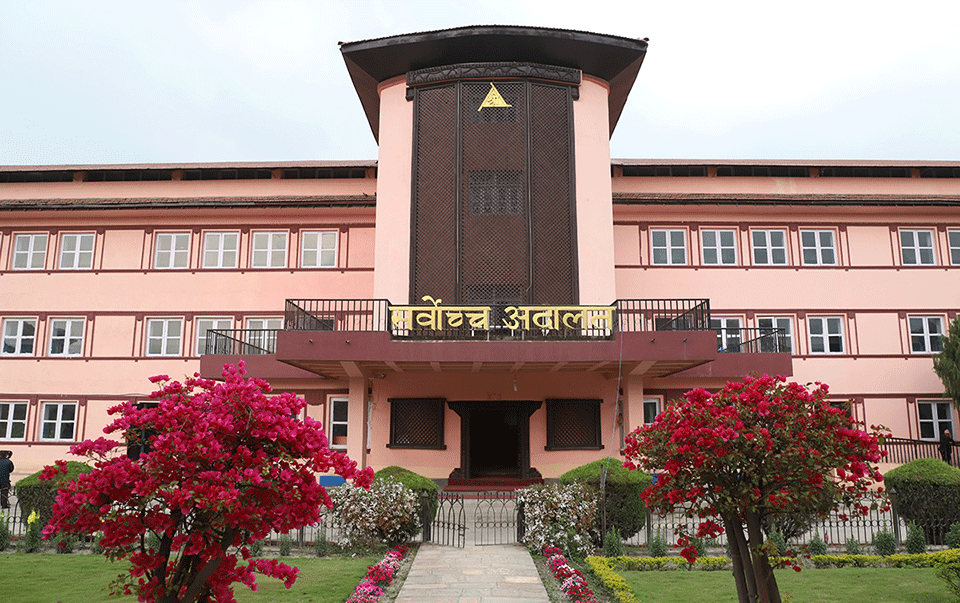
KATHMANDU:- The Supreme Court has ruled that the law does not prohibit kidney transplantation in Nepal for a Bhutanese refugee, even though they are not a Nepali citizen.
Although a Bhutanese refugee sought to donate a kidney to his wife for a transplant at Ashwini Medical College and Hospital Pvt. Ltd. (Medicity) in Lalitpur, the hospital refused to proceed at the last minute.
While hearing a writ petition filed against the refusal, a joint bench comprising Justices Sharanga Subedi and Nripadhwaj Niraula issued a writ of mandamus on Monday ordering the transplant to proceed, noting that the matter—despite involving a non-Nepali citizen—is fundamentally linked to the right to life.
The court ruled that it is inappropriate to deny medical treatment in a sensitive matter concerning life and death by relying solely on a literal interpretation of the law.
Kharka Bahadur Gajmer, a Bhutanese refugee residing in the Beldangi camp in Jhapa, had initiated the process at Medicity Hospital for his wife Sara Gajmer’s kidney transplant.
The hospital rejected the transplant on Asar 8, citing the lack of clear legal provisions regarding refugees and the inability to produce a certified refugee identity card for Sara, who was undergoing dialysis after both her kidneys had failed.
Although the marital relationship between the husband and wife was verified, the hospital had refused to proceed with the process because the Human Body Organ Transplantation (Regular and Prohibited) Act, 2055, lacked clear provisions regarding refugees.
The Supreme Court issued an order stating that individuals cannot be denied medical treatment solely due to a lack of citizenship, noting that Article 16(1) of the Constitution of Nepal guarantees the right to live with dignity and Article 35 guarantees the right to health.
The Supreme Court has quashed the hospital’s decision of Asar 8 through a writ of certiorari, ruling that denying medical treatment—a matter linked to the right to life—would endanger the lives of the petitioner and his wife, even though they are not Nepali citizens.