Mugu residents also pay taxes to deities
The first is a tax paid through the offering of crops in return for the use of land. The second is a customary tax associated with disputes, where a person seeking justice symbolically offers soil to the deity. In such cases, the Dhami determines the amount of tax to be paid.
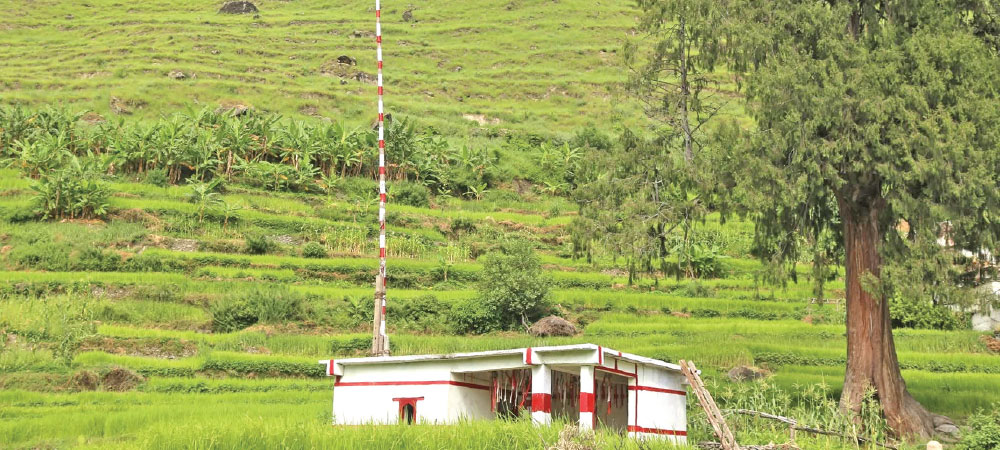
MUGU:- The tradition of paying annual taxes in the name of Gura Devata (local deities), based on customary religious beliefs, is still practised in several villages of the Himalayan district of Mugu.
Under this long-standing tradition, locals offer grain crops such as barley, wheat and rice to the deities each year in return for the use of cultivable land. The practice has been passed down through generations.
Gyan Prasad Bhatta, a social worker from Soru Rural Municipality-6, said that in some villages of Mugu, as well as in Humla, Dolpa, Jumla and Achham, it is customary for each household to contribute food grains in exchange for using land. The collected grains are used for deity worship, religious processions and community rituals.
He said there is a tradition of offering anywhere from one mana (a traditional Nepali unit of measurement) to one pathi of grain to the landowner, depending on an individual’s willingness.
According to local custom, paddy harvested in October/November and barley and wheat harvested in May/June are regarded as pure and are therefore offered to the deities.
Bhatta said that he offers six pathis of rice to the Gura Devata every year. According to local belief, regular offerings to the deity bring happiness, peace, prosperity and good health to the family.
Janak Bahadur Aidi, a Dhami (traditional shaman) of Gura Devata from Chhayanath Rara Municipality-6, said that this tax is not mandated by government law but is a social and cultural obligation that has continued for generations.
Bhakta Bahadur Malla of Chhayanath Rara Municipality-1 said there are two types of taxes paid to the Gura Devata.
The first is a tax paid through the offering of crops in return for the use of land. The second is a customary tax associated with disputes, where a person seeking justice symbolically offers soil to the deity. In such cases, the Dhami determines the amount of tax to be paid.
In some places, people offer a goat to the Gura Devata, while in others, offerings include barley, wheat, rice or goats.
According to locals, the tradition has helped strengthen community unity, mutual cooperation, religious faith and cultural identity.
Bishnu Kumar Bham, Mayor of Chhayanath Rara Municipality, said such traditions play an important role in maintaining social harmony.
He added that despite the influence of modern lifestyles and the growing trend of young people leaving villages for employment and education, Himalayan communities are making efforts to preserve their indigenous culture.