
325-year-old Chemjong ancestral house falls into disrepair
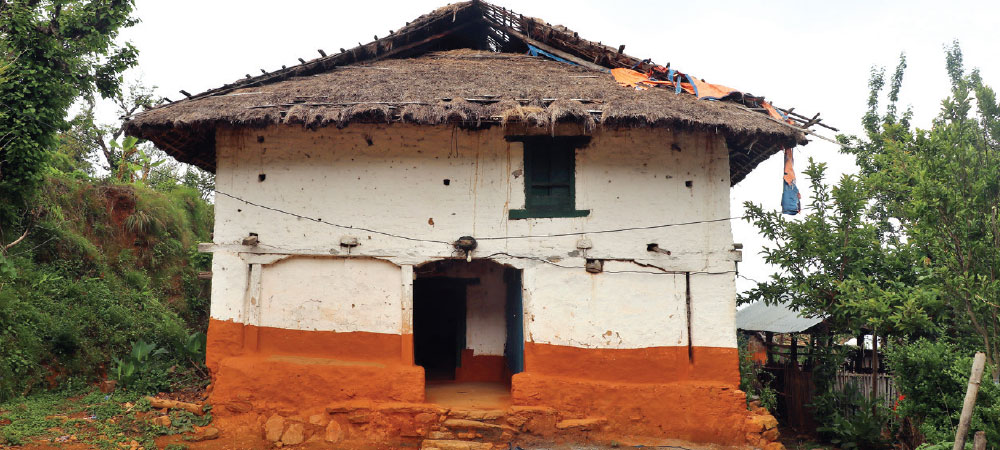
By Kabiraj Ghimire,DHANKUTA:- A centuries-old house stands on a large plateau at Maunabudhuk, Chaubise Rural Municipality-7, Dhankuta, surrounded by modern homes.
The ageing structure, adorned with traditional craftsmanship, contains six hearths on its upper floor and several stone grinding mills.
Although the roof has been repaired, it now leaks, and the historic building is widely recognised as the ancestral home of the Chemjong clan.
The Chemjongs of Dhankuta are believed to have originated from this house.
The approximately 325-year-old six-hearth house has been gradually deteriorating due to inadequate conservation.
Located about 25 kilometres from the eastern hill tourist destination of Bhedetar, the house was built using stone, mud and traditional construction materials.
It still retains six traditional hearths, three stone grinding mills, a staircase made of stone and mud, and a traditional mud granary.
The timber structure has begun to decay, the roof leaks, cracks have appeared in the mud-brick walls, and many of the historic artefacts inside are in a poor state.
Although local residents and the Chemjong Lineage Development Association have been trying to preserve the house, no effective conservation initiative has been undertaken by the government.
Caretaker Manmaya Chemjong said she has been doing her best to maintain the ancestral home despite limited resources.
She lived in the house until a few years ago but later built a separate residence nearby.
“It is our ancestral home. My husband has passed away, and my son and daughter-in-law live elsewhere. I do what I can – I plaster the walls with mud and carry out minor repairs,” she said.
Local Santosh Chemjong said that although the roof had been repaired in the past, the lack of continued maintenance has left the house in a dilapidated condition.
Locals have called for the building to be listed as an archaeological heritage site, for the Department of Archaeology to be informed, and for Chaubise Rural Municipality to include its conservation and promotion in its annual development programme.
According to the Chemjong genealogy, Kedaba, the youngest son of Payanggumba, built the first house on the site around 425 years ago.
About 325 years ago, Peyungnamba, a descendant four generations later, rebuilt the house in its present form, constructing six separate hearths under one roof and dividing the house among his six sons, said Teka Ratna Chemjong, central president of the Chemjong Lineage Development Association and a researcher on the family’s history.
The house has since become popularly known as the ‘Six-Hearth House’.
However, another historical account presents a different version. According to former headmaster Krishna Govinda Chemjong in his book Historical Study of Chaubise Thum, the house was built by Asman Chemjong.
He writes that Asman’s eldest son, Adal Singh, travelled to Kathmandu to obtain official permission to install a tiled roof, but by the time he returned, his younger brothers had already divided the house.
Despite these differing accounts, both the oral history and genealogical records indicate that the house is at least three centuries old.
The ancestral homeland of the Chemjong family is believed to be Chemphuwajang in the Charkhola area of Ilam.
According to the family’s genealogy, Payanggumba (Chemphojanghang) was born there, and the Chemjong surname is believed to have originated from his name.
His sons, Ladohang and Chikwahang, travelled from Chemphuwajang towards their ancestral stronghold at Kurule Padhe Yak, eventually reaching Chuksenga (present-day Kholagaun).
Kedaba, the youngest son of Ladohang, later migrated from Chuksenga to Maunabudhuk in Dhankuta, where he established the family’s first permanent settlement.
Stone markers erected by the six brothers according to Mundhum tradition can still be seen on a plateau beside the house. Local regard them as important historical evidence of the division of the lineage.
Locals have urged authorities to preserve the house and develop it as a cultural and heritage tourism destination, saying it represents not only a unique architectural tradition but also an important chapter in the history of Limbuwan.
Chairman of Chaubise Rural Municipality Raj Kumar Chemjong said the house holds deep historical, cultural and archaeological significance.
He added that the municipality has requested financial support from both the federal and provincial governments for its conservation.
While the local government has carried out whatever preservation work it can afford, he said the restoration requires substantial funding that exceeds the municipality’s capacity. RSS