“We stand together with government and affected citizens amidst catastrophe caused by Bhote Koshi floods.”

LALITPUR:- Nepali Congress General Secretary Gagan Kumar Thapa has stated that they wish to reassure everyone that the government stands in solidarity with the citizens suffering from the catastrophe caused by the Bhote Koshi floods.
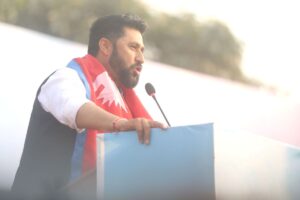
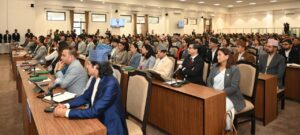
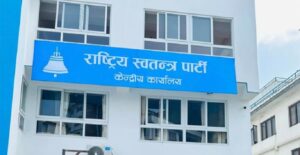
Addressing the meeting of the Central Working Execution Committee held today at the Nepali Congress central office in Sanepa, President Thapa emphasized that this disaster was not merely an ordinary natural calamity but a “mega-disaster” involving massive human loss, and stressed that the state must mobilize its maximum resources for rescue, relief, restoration, rehabilitation, and reconstruction efforts.
“We want to assure everyone that the government stands in solidarity with citizens facing this great calamity; we will remain by their side every step of the way—going wherever is necessary—and will provide support by exerting extraordinary effort, not only for tasks within our capacity but even for those that seem beyond it,” he said.
Expressing condolences on behalf of the party to those who lost their lives in the floods, Chairman Thapa voiced hope that the missing citizens would be found safe, noting that the rescue of survivors kept that hope alive.
He remarked that the aftermath of this disaster cannot be compared to past natural calamities, highlighting that many families have lost multiple members simultaneously and entire communities are in collective mourning.
“While protocols for relief, restoration, rehabilitation, and reconstruction are certainly needed there, what is even more important right now is compassion and goodwill; sympathy and empathy are required,” he said.
While sharing details from his field visit to the flood-affected areas of Nuwakot and Rasuwa, Chairperson Thapa recounted the harrowing stories of the victims, noting that in some families, elderly parents, children, and other relatives had been swept away by the floods, leaving only one or two family members alive.
He emphasized the need for long-term support and guardianship for the affected families, alongside the provision of food, clothing, and other material aid. Chairperson Thapa stressed that the protection of children who have lost all their family members due to the floods must be a priority for both the state and society.
Recounting a meeting with the grandmother of a boy who lost his family in the disaster, Chairperson Thapa emphasized the child’s need for education, protection, and guardianship. “Families need to extend a helping hand to one another; the entire society and community have been struck by a massive calamity. There is a need for people to step forward and offer support,” he said.
Chairperson Thapa stated that the state should not view relief distribution merely as the provision of material aid but should also take into account the mental and social well-being of the victims. He drew the government’s attention to the need to immediately simplify legal provisions, noting that the legal status of citizens missing for a long period has created further uncertainty for the affected families.
Chairperson Thapa stated that a provision should be made to initiate necessary legal procedures at the local level by treating family members as the point of contact in special emergency situations. He emphasized that there should be no delay in seeking international assistance if the manpower, technology, and equipment available in Nepal are insufficient for the rescue of citizens trapped in the tunnel.
He stated that although Nepal possesses experience in tunnel construction and the necessary technical manpower, its capacity to deploy specialized tunnel rescue teams and heavy equipment to the scene immediately remains limited.
“We possess the capacity, knowledge, and experience to construct tunnels spanning hundreds of kilometers. However, we may lack the capability to airlift the specialized teams and heavy equipment required for tunnel rescue operations,” said Chairperson Thapa. He emphasized that, in such a scenario, it is essential to integrate the technicians, experts, the Nepal Army, disaster management agencies, and other relevant stakeholders into a unified decision-making mechanism from the very outset. Chairperson Thapa noted that seeking international assistance is a standard procedure when domestic capabilities prove insufficient.
Chairman Thapa has questioned the conflicting statements issued by government bodies regarding the tunnel rescue operation. Noting the Prime Minister’s claim that coordination with the international community for the rescue began immediately after the disaster struck, Thapa pointed out that this statement was inconsistent with what the government spokesperson had said earlier.
“This is not the time to assign blame or engage in a blame game; instead, we must mobilize all necessary resources for rescue operations wherever lives can still be saved,” said Chairperson Thapa. He emphasized the need for more effective coordination among the government, security agencies, local, provincial, and federal governments, technical personnel, media professionals, volunteers, and political parties to ensure that rescue and relief efforts are carried out efficiently.