Rural settlements in Lamjung emptying, villages becoming limited to memories
The primary challenge now lies in creating conditions where smoke rises once again from empty houses, fallow land becomes productive, and the village's unique character is preserved. To achieve this, it is essential to modernize agriculture, promote tourism, boost local production, and expand employment opportunities within the villages. Stakeholders have expressed concern that, failing this, these villages could become nothing more than a story of the past.
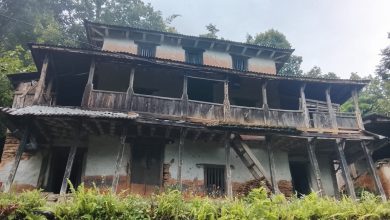
LAMJUNG:- Many rural settlements in Lamjung are becoming deserted. Padlocked old houses, courtyards overgrown with weeds, crumbling structures, and fallow land have become the defining features of these villages.
The traditional resting platforms (*chautaras*) and settlements are silent; the villages feel desolate. Places that bustled with activity just a few years ago are now becoming devoid of people. Although amenities such as roads, electricity, drinking water, and communication facilities have reached these villages, they are emptying out as residents leave for cities or foreign countries in search of employment, education, and healthcare.
Its impact extends beyond just houses and land; it has affected social relationships, culture, the local economy, and traditional skills. The old Newar settlement of Shrimanjyang in Dordi Rural Municipality-3 is gradually emptying out. Once densely populated a few decades ago, the area is now sparsely inhabited; many houses stand empty, while others are in a dilapidated state.
According to 85-year-old Sher Bahadur Shrestha, the village used to bustle with activity from morning till evening. Villagers would all participate in festivals, fairs, and social activities. He notes that with so many people having left the village, the lively and cooperative atmosphere of the past no longer exists.
The situation in Sikra village of Harabot, Rainas Municipality-8, is much the same. According to local resident Lalmaya Shrestha, the village used to be populous even though amenities were lacking; now, despite the addition of facilities, the number of residents has declined. As the village empties out, the agricultural sector is also feeling the impact.
According to Saroj Thapa, Information Officer at the Agriculture Development Office in Lamjung, the exodus of the younger generation has led to a shortage of agricultural labor. This has resulted in arable land lying fallow and a decline in agricultural production. He notes that it has become difficult to pass down traditional farming skills, indigenous crops, and local knowledge to the new generation.
According to the Agriculture Development Office, out of 61,819 hectares of arable land in Lamjung, cultivation is taking place on only 45,757 hectares; 16,062 hectares remain fallow. Purano Dihi village in Sundarbazar Municipality-6 has also been affected by migration. According to local resident Madan Regmi, the village—which once comprised around 50 households—has now become sparsely populated.
The decline in the village population has impacted agriculture, local culture, and social activities. Buna Kumari Rimal, Deputy Chief of the District Coordination Committee, Lamjung, stated that the depopulation of villages presents social, cultural, and economic challenges.
According to her, the absence of the younger generation in the villages makes it difficult to pass on language, customs, culture, and traditional knowledge to the new generation.
According to Bichha Bahadur Gurung, Vice-Chairperson of Dordi Rural Municipality, it is essential to strengthen the foundation for income generation to retain the population in the village. He stated that agriculture and tourism have been prioritized for this purpose.
The rural municipality is working on operating homestays, promoting agriculture, and linking local produce to markets. Efforts are being made to generate income for farmers through the production of crops such as coffee and chili peppers. The depopulation of villages is not merely an issue of empty houses; it is a matter deeply connected to agriculture, culture, and the local economy. Preserving these villages requires the modernization of agriculture, the development of tourism, and the creation of local employment opportunities.
Efforts are underway to conserve and integrate religious and tourist sites in the Dordi region—such as Ilampokhari, Dudhpokhari, Memepokhari, and Barapokhari—into the tourism sector. The 2021 National Census has also revealed a rising trend of internal migration across the country, an impact of which is evident in the rural areas of Lamjung. The emptying of villages is not merely a story of vacant houses; it reflects a pattern of decline common to numerous settlements throughout the nation.
The primary challenge now lies in creating conditions where smoke rises once again from empty houses, fallow land becomes productive, and the village’s unique character is preserved. To achieve this, it is essential to modernize agriculture, promote tourism, boost local production, and expand employment opportunities within the villages. Stakeholders have expressed concern that, failing this, these villages could become nothing more than a story of the past.