Poland halted asylum claims at the Belarus border and now wants Europe to follow its example
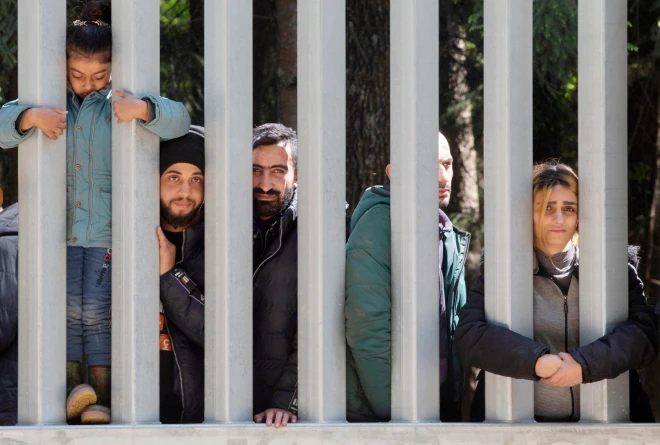
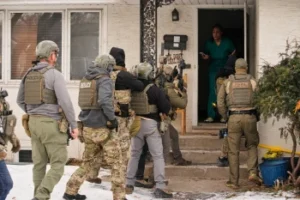
WARSAW, Poland (AP):- When Poland stopped registering asylum applications from migrants entering from Belarus in March 2025, authorities presented it as a temporary emergency measure to counter what they saw as a push by Russia and its ally Belarus to destabilize the country by directing tens of thousands of migrants toward the European Union.
But the policy has remained in force for the past 18 months, and Poland is now urging the 27-nation bloc to allow temporary suspensions of asylum applications during episodes of “instrumentalized” mass migration elsewhere — a move that rights advocates warn could violate international law.
The border between Poland and Belarus, a non-EU country that is aligned with Russia, runs for about 400 kilometers (250 miles).
Since 2021, EU authorities have accused authoritarian Belarusian President Alexander Lukashenko of weaponizing migration by luring people to his country to find an easier entry point into the bloc than the more dangerous routes across the Mediterranean Sea.
European Commission announces new emergency framework
The prospect of an EU-wide approach appeared to move closer on Sept. 16, when European Commission President Ursula von der Leyen announced that the EU executive branch would soon propose a new “European emergency response framework” for cases of “engineered and weaponized” mass migration.
The new emergency framework would allow for “flexibility” in applying standard migration procedures under specific circumstances and for a limited period of time, she said.
Von der Leyen didn’t specify what procedures would be made flexible. It’s unclear what form this proposed framework would take, whether it would need approval from the EU Parliament and EU leaders, and how soon it might come into practice. The European Commission didn’t respond to requests from The Associated Press to list those procedures.
But Poland’s deputy interior minister in charge of migration, Maciej Duszczyk, celebrated the announcement as a sign that Europe was becoming interested in what he calls “the Polish solution.”
“We are happy that what we’ve been saying for a year, or a year and a half, is now becoming mainstream in the EU,” Duszczyk told the AP in an interview.
He said that the July border crisis in Ceuta, when more than 70,000 people suddenly crossed from Morocco into the Spanish enclave in North Africa, “made the EU realize” that other countries can be affected by similar border crises as Poland.
Tineke Strik, a Dutch member of the European Parliament, told the AP that she fears von der Leyen’s new emergency framework is indeed poised to take the Polish model EU-wide and legitimize the curtailing of asylum.
“If you normalize it, if you make it the default policy of all EU member states, you (the Poles) are not falling outside of the framework,” Strik said. “It simply has been legalized.”
“That would of course really undermine the core of the European and international asylum law — namely that people always must have the possibility to ask for asylum before they can be returned because otherwise you don’t know what will happen to them,” she said.
Michael O’Flaherty — the human rights commissioner for the Council of Europe, which is unrelated to the EU — said that the fact that the suspension of the right to asylum now appears in discussions at the EU level “worries” him because “it can very easily cross the line into a violation of international law.”
Critics say legalizing the suspension of asylum would constitute a major blow to fundamental human rights, particularly the principle of non-refoulement, which bars countries from returning people to places where they may face persecution. The principle was enshrined in the postwar refugee protection system after Jews and others fleeing Nazi persecution were refused safe haven during World War II.
‘Polish solution’ contrary to international law, rights groups say
Duszczyk said that the suspension of the right to asylum in Poland is fully compatible with international law and that people in the most vulnerable categories — pregnant women, children or those facing persecution in Belarus — can still apply for asylum even under the current system.
“Each person who appears on the border has the right to speak to the Polish border guards and explain their situation,” Duszczyk said.
But the Polish ombudsman and nongovernmental organizations assisting migrants on the border contradict the minister.
“Visibly pregnant women might stand a chance, but in the case of sick people or teenagers who are minors, their arguments are typically undermined,” said Karolina Czerwinska from the Association for Legal Intervention, a Polish NGO offering legal aid to migrants.
Duszczyk said that the world today has changed since the 1950s, when countries recovering from the traumas of World War II created a system of international law, including refugee rights, meant to protect individuals from state violence.
Czerwinska said that “we Poles located on the front lines of the war in Ukraine should really make sure human rights are respected. We may need to make use of them ourselves.”
EU’s new migration pact already outdated, Poland says
Human rights groups said that von der Leyen’s announcement came as a surprise, because the EU’s new Pact on Migration and Asylum, which took effect three months ago, already allowed countries faced with border crises to deviate from standard asylum procedures by extending deadlines for processing applications and holding migrants in detention for longer periods of time.
But Duszczyk said that von der Leyen’s announcement meant that the European Commission recognized the new pact was “not enough” and that “we need a new instrument in EU law which guarantees that sometimes we can suspend normal procedures and have a sort of state of emergency.”
According to the Polish minister, the European Commission is expected to give more details about the framework during a summit of interior ministers on Oct. 1, and discussions would continue during a European Council summit later that month.