NRNA USA President Sah suggests distributing non-resident Nepali citizenship and identity cards online
In accordance with the Supreme Court's order, calls have been made to arrange voting for Nepalis abroad—either through diplomatic missions or via technology—and to issue directives enabling Non-Resident Nepalis (NRNs) to access the secondary share market, as well as to operate 'Diaspora Bonds' and a 'Motherland Fund.' It has been proposed to establish a joint ‘Single Service and Grievance Redressal Desk’—comprising representatives from the Ministry of Foreign Affairs, the Investment Board, and the Department of Industry—to facilitate investors, and to operationalize a ‘Diaspora Expert Network’ and a ‘Knowledge Bank’ through an executive decision even before the enactment of the relevant legislation.

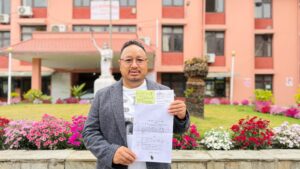
NEW YORK:- The Non-Resident Nepali Association National Coordination Council (NRNA NCC) of the USA has submitted a 17-point set of suggestions to Foreign Minister Shishir Khanal, who is currently in New York to attend the 81st session of the United Nations General Assembly.
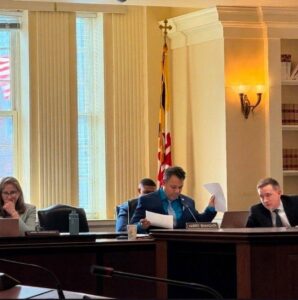
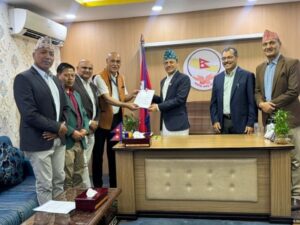
A team led by NCC President Satendra Sah met with Minister Khanal and submitted a memorandum addressing the issues and rights of Non-Resident Nepalis (NRNs) and the diaspora’s participation in Nepal’s development. Recalling the collaboration with the government on relief and reconstruction efforts following the floods in Bhote Koshi and Rasuwa, the memorandum emphasizes the need to revise the draft Non-Resident Nepali Act (2083 BS), ensure the practical implementation of NRN citizenship, guarantee investment security, and establish provisions for voting rights from abroad.
The proposal calls for the formation of a joint technical task force comprising the Ministry of Foreign Affairs and the NRNA to finalize the Non-Resident Nepali Act. Furthermore, it urges immediate amendments to—or the issuance of a mandatory timeline for amending—laws related to land revenue, immigration, foreign currency, and securities to facilitate the practical implementation of NRN citizenship.
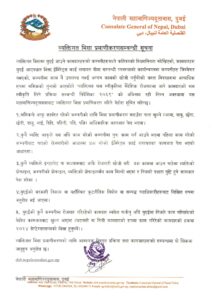
It has also been suggested that arrangements be made to collect applications for Non-Resident Nepali (NRN) citizenship and distribute online identity cards directly through Nepali diplomatic missions abroad. The memorandum calls for the regularization of assets acquired prior to the enactment of the Act, tax exemption on annual family remittances of up to Rs 25 million, the seamless repatriation of capital and dividends, and the retention of the facility for a free 10-year multiple-entry visa.
In accordance with the Supreme Court’s order, calls have been made to arrange voting for Nepalis abroad—either through diplomatic missions or via technology—and to issue directives enabling Non-Resident Nepalis (NRNs) to access the secondary share market, as well as to operate ‘Diaspora Bonds’ and a ‘Motherland Fund.’ It has been proposed to establish a joint ‘Single Service and Grievance Redressal Desk’—comprising representatives from the Ministry of Foreign Affairs, the Investment Board, and the Department of Industry—to facilitate investors, and to operationalize a ‘Diaspora Expert Network’ and a ‘Knowledge Bank’ through an executive decision even before the enactment of the relevant legislation.
Emphasis has been placed on adding adequate staff to high-demand missions to strengthen consular services, transferring positions from missions slated for closure, fully digitizing consular services, establishing permanent emergency rescue teams and 24/7 hotlines for the Gulf and conflict-affected regions, and setting up legal aid funds for workers and students at the missions.
A demand has been made to establish a dedicated ‘Diaspora Coordination Center’ under the Ministry of Foreign Affairs to foster long-term collaboration, and to expand access to Nepali language classes and open university programs for second- and third-generation Nepali children. A team led by Sunil Sah, Chief Patron of NRNA USA, prepared the draft of this proposal.
Upon receiving the memorandum, Foreign Minister Khanal stated that it is the government’s policy and priority to engage the diaspora as a key partner in Nepal’s economic transformation. Outlining the government’s vision for leveraging the knowledge, skills, capital, technology, and networks of the Nepali diaspora for the country’s economic development and transformation, Minister Khanal also emphasized the commitment to further strengthening bilateral relations.