
Indian-American vote becomes decisive in November midterm elections
In the 2026 election cycle, campaign contributions from Indian-Americans for the midterm elections are poised to break all previous records.
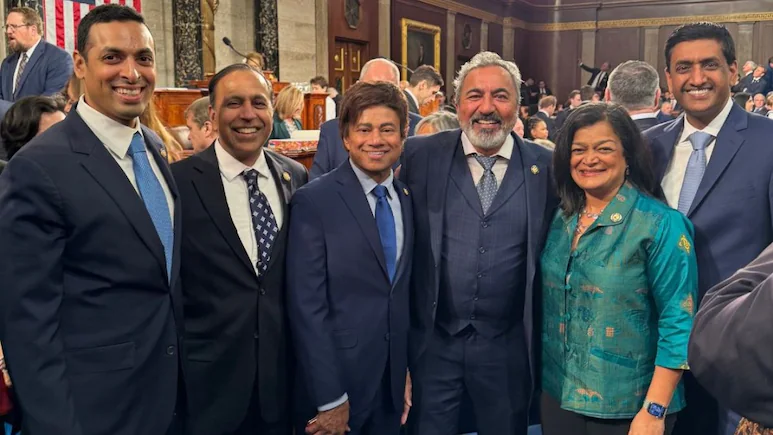
WASHINGTON:- In mainstream American politics, Indian-Americans have moved to the center of electoral debates for both Republicans and Democrats, and Indian-American politicians have established immigration as a key issue on the agendas of both major political parties.
With a population of approximately 5.2 million, this community is the second-largest immigrant group in the United States and ranks among the highest-earning and most highly educated communities. For U.S. President Donald Trump—who is facing the first major test of his second term—the economic stability and votes of Indian-Americans appear poised to prove decisive in several hotly contested electoral districts.
Prior to 2012, only two Indian-Americans had served in the U.S. Congress: Democrat Dalip Singh Saund from California (1957–1963) and Republican Bobby Jindal from Louisiana (2005–2008).
The 2012 victory of Democratic candidate Ami Bera from California’s 3rd Congressional District further bolstered the steadily growing presence of Indian-Americans in the House. Subsequently, Ro Khanna, Pramila Jayapal, and Raja Krishnamoorthi entered the House in 2017, followed by Shri Thanedar in 2023 and Suhas Subramanyam in 2025.
However, this upward trend might face a pause this year; with Congress members Krishnamoorthi and Thanedar preparing to leave the House, and unless Democratic candidates Amish Shah (in Arizona) or Pia Dandiya (in Florida) win their tightly contested races, the number of Indian-Americans in the U.S. House of Representatives could drop from six to four following the November 3 election.
All six Indian-American members currently in the House—informally known as the “Samosa Caucus”—belong to the Democratic Party: Ami Bera, Ro Khanna, Pramila Jayapal, Krishnamoorthi, Thanedar, and Suhas Subramanyam.
It is unlikely that the number of members in this group (caucus) will exceed six in January, as no other Indian-American candidates are in competitive races for the House. Republican candidates Ritesh Tandon, Nirav Seth, and Mahesh Ganorkar are all running in districts where Democrats hold a strong grip.
According to the Washington-based think tank ‘Carnegie Endowment for International Peace,’ there are approximately 2.6 million eligible Indian-American voters in the United States. Although this community represents a small fraction of the total electorate, they are primarily concentrated in areas where election margins tend to be very narrow: Pennsylvania, Michigan, Georgia, Texas, New Jersey, and the suburbs surrounding Atlanta and Washington.
In this cycle of midterm elections, where the outcome will be determined by votes cast in a handful of closely contested constituencies and states, even a slight shift in the leanings of this voter group could carry significant weight.
According to a recent survey, Indian-American voters are leaning towards the Democratic Party ahead of the US midterm elections in November; however, many Asian-American and Pacific Islander voters feel politically insecure due to Trump’s anti-immigration agenda.
Data from the ‘Asian American and Pacific Islander Voter Survey’ conducted by ‘AAPI Data’ and ‘APIAVote’ shows that 66 percent of Indian-American respondents favored the Democratic candidate for the Senate, while 22 percent preferred the Republican candidate.
According to the survey, 90 percent of registered Indian-American voters plan to vote in the midterm elections, with 71 percent stating they are certain they will do so. For this reason, Indian-American voters are considered particularly important in states where the competition is tight.
The Indian-American community in the United States is among the highest-earning ethnic groups; the community’s median household income exceeds $150,000, which is nearly double the national median.
With a strong presence in high-profit sectors such as Silicon Valley, Wall Street, healthcare networks, corporate law, and commercial real estate, the community possesses significant disposable income capable of financially supporting political contests or election campaigns.
In the 2026 election cycle, campaign contributions from Indian-Americans for the midterm elections are poised to break all previous records.