Ex Gurkhas give UK government until December ultimatum to maintain equal pensions
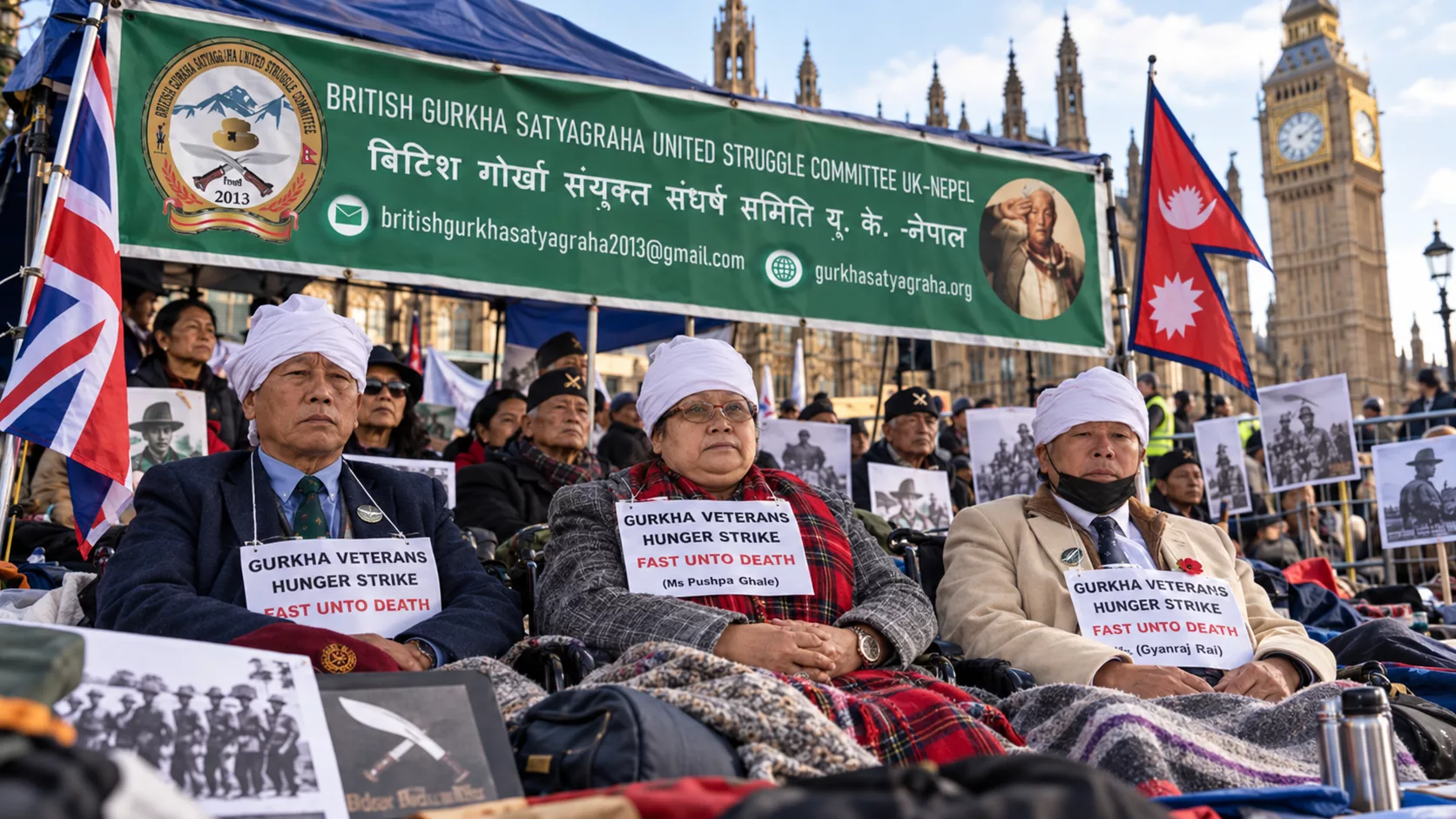
LONDON:- The Gurkhas—who boast a history of over two hundred years of service, dedication, and sacrifice in the British Army—have once again approached the British government to demand their rights and equal treatment. Citing a lack of expected results from years of negotiations, government commitments, and various phases of protest, the British Gurkha Satyagraha Joint Struggle Committee has issued a formal ultimatum to the British government to resolve the outstanding issues by December 31, 2026.
In a letter sent to British Prime Minister Andy Burnham on October 1, Krishna Bahadur Rai, the chief coordinator of the committee, warned that if the key demands of the Gurkhas are not addressed within the stipulated timeframe, peaceful protests, hunger strikes, and solidarity movements would be resumed in both the UK and Nepal.
This warning represents not so much the start of a new Gorkha movement as a continuation of dissatisfaction regarding long-unfulfilled commitments. According to the struggle committee, Gorkhas have served the British Crown with loyalty for generations, yet issues concerning pay, pensions, resettlement, identity, and equal treatment remain unresolved.
The letter recalls the 1923 UK-Nepal Treaty of Friendship and the 1947 Tripartite Agreement, reiterating the demand for the implementation of provisions ensuring that Gurkhas serving in British units receive equal treatment alongside other members of the main army. According to the struggle committee, although the spirit of the agreement is clear, Gurkhas have faced inequality in practice for decades.
A government-to-government dialogue between Nepal and the UK was initiated in 2017 to address the Gurkha issue. As a result, a technical committee report covering various aspects was prepared in 2018. This report was viewed as a crucial foundation for a long-term resolution to the Gurkha issue. However, according to the struggle committee, years have passed since the report was finalized, yet its key recommendations remain unimplemented.
After a long wait, dissatisfied Gurkha campaigners once again took to the streets and staged hunger strikes in 2021. Subsequently, on August 19, 2021, an agreement was reached on a framework to resolve the remaining Gurkha issues through government-to-government negotiations, based on the 2018 technical report. British officials at the time had also pledged to move towards resolving the issue. However, according to the committee, the expected results did not materialize even after that.
The issue of equal pensions has remained one of the most sensitive aspects of the Gurkha movement. The struggle committee has consistently demanded that equal pensions be granted to Gurkhas, with retrospective effect from their past service periods. Citing the example of the 1999 John Spellar review—which introduced retrospective changes to the Gurkha pension system—the letter argues that a similar principle could be applied in the present instance as well.
The committee has also raised serious questions regarding the provisions governing the calculation of service duration under the ‘Gurkha Offer to Transfer’ scheme. The letter cites an example where actual service of 33 years prior to 1997 was effectively reduced to the equivalent of approximately nine years for pension calculation purposes. Similarly, the committee highlighted the precedent set during the 1948 transfer from the Indian Army to the British Army, where service rendered in the Indian Army was recognized on a one-to-one basis for pension and gratuity purposes.
The struggle committee has also demanded a clear response from the UK government regarding the legal status of the tripartite agreement. The letter asserts that the interpretation—whereby the agreement is not considered subject to judicial review under UK domestic law—has made it difficult for ex-Gurkhas to seek legal redress. On this basis, the committee has raised a crucial question: if the tripartite agreement is not legally enforceable, what is the legal and reciprocal basis for recruiting Nepali citizens into the British Army since 1948?
The Gurkha movement is currently raising issues that go beyond just pensions; matters such as identity, military status, and the transparency of historical documents have also become significant aspects of the movement. The committee has stated that two letters sent by its independent advisor, retired Lieutenant Colonel Hamish Adams—seeking a written response to the fundamental question, “Are Gurkhas soldiers of the British Army?”—remain unanswered.
The committee has presented this issue not merely as a routine administrative query, but as a matter directly linked to the constitutional and military identity of the Gurkhas. Therefore, the memorandum demands that the British government provide a clear and formal written response regarding this matter.
Similarly, a demand has been made to make public historical records related to Gurkha recruitment and terms of service. The committee has raised questions regarding transparency, noting that old files—which ought to be accessible under regulations concerning public records—remain unavailable.
Time has become a major concern for the leaders of the Gorkha movement. The struggle committee claims that more than 20,000 affected ex-Gorkhas have passed away since the movement began. Noting that many of the remaining ex-servicemen have reached old age and their numbers are dwindling year by year, the committee has warned that any further delay could extinguish the opportunity to secure justice.
The letter states, “Any further delay is not merely inaction; it is permanently depriving those who have waited a lifetime for justice of that justice.”
Reiterating its long-standing demand for equal treatment for Gurkhas recruited between January 1, 1948, and September 30, 1993, the struggle committee has urged the UK government to ensure that the next generation does not have to wait for justice.
Despite the stern ultimatum, the struggle committee has kept the door open for dialogue. The committee has stated that it is ready to sit for talks with the UK government at any time to reach a just and long-term solution.