Agreement on climate cooperation and carbon finance between Nepal and South Korea
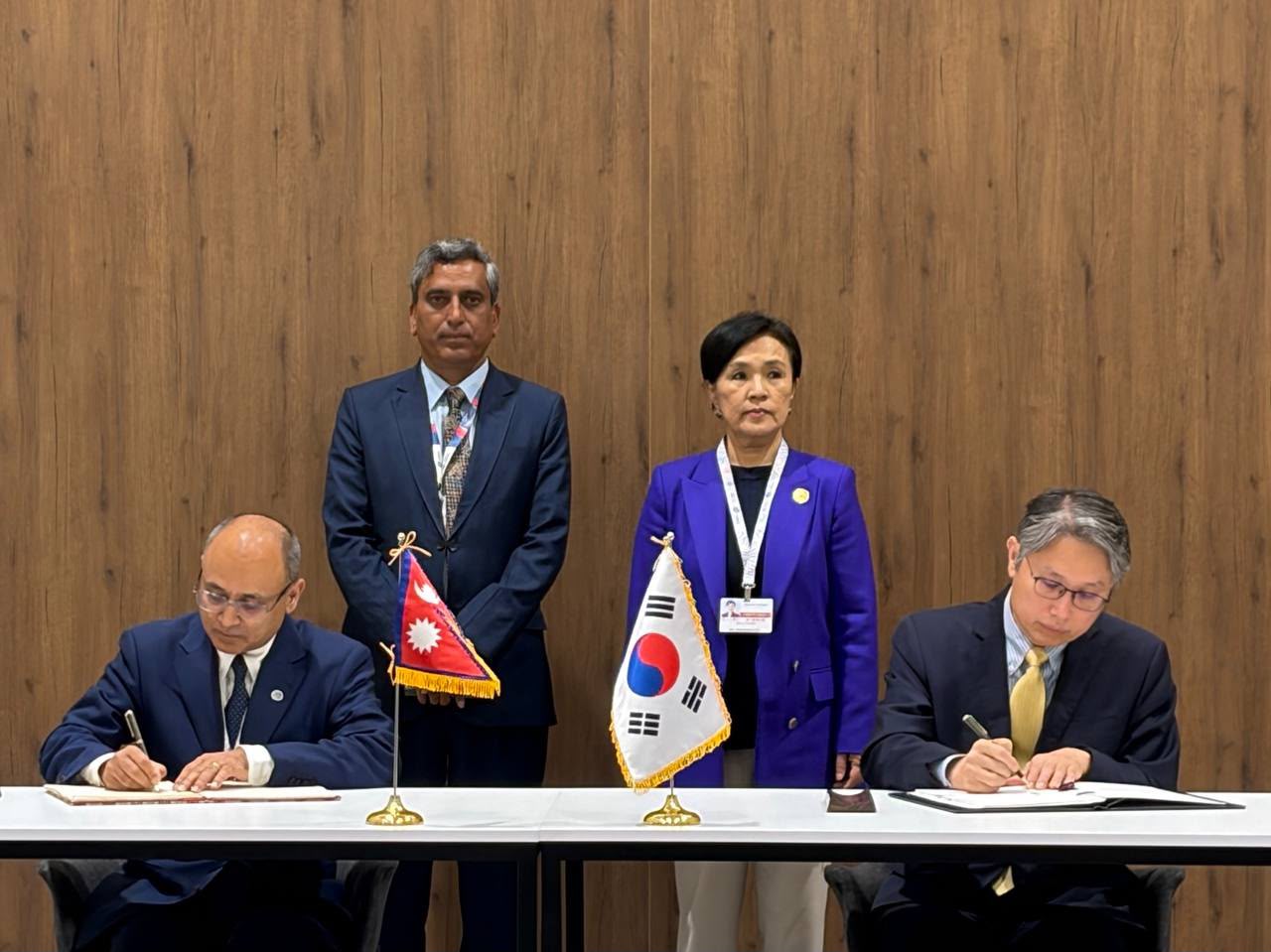
Antalya, Turkey:- A framework agreement on cooperation regarding climate change has been signed between Nepal and the Republic of Korea (South Korea), with the objective of mitigating climate change, mobilizing carbon finance, and reducing greenhouse gas emissions.
Concluded under Article 6 of the Paris Agreement, this agreement is expected to create new opportunities for cooperation between the two nations in areas such as carbon markets, climate-friendly investment, technology transfer, climate adaptation, and sustainable development.
Under the agreement, Nepal and South Korea can develop projects related to emission reduction and facilitate the transfer of internationally recognized emission reduction outcomes. It is expected that this will mobilize international carbon finance and promote investment from both the public and private sectors in the areas of climate adaptation and mitigation.
The agreement identifies renewable energy, transport, industry, buildings, waste management, agriculture, and the forestry sector as priority areas for cooperation. In these sectors, the development of climate-friendly projects, the expansion of investment, and the use of modern technology will be encouraged.
Similarly, the agreement includes provisions for transparent accounting, monitoring, reporting, and verification (MRV) of carbon emissions, as well as adjustment processes and measures to prevent the double counting of emission reductions. This will help maintain environmental integrity in carbon trading and support the fulfillment of international climate commitments.
In addition to carbon markets, the two countries will also collaborate in areas such as climate science, research, technological innovation, climate adaptation, methane emission reduction, and a just energy transition. The agreement stipulates that knowledge, skills, and technology will be exchanged among government agencies, universities, researchers, investors, and private sector entities to facilitate this cooperation.
This agreement is also expected to be significant for implementing Nepal’s Nationally Determined Contribution (NDC) 3.0, enhancing climate resilience, and achieving the goal of net-zero greenhouse gas emissions by 2045.
A Joint Committee on Climate Change Cooperation, comprising government representatives from both countries, will be established to oversee the implementation of the agreement, the approval of the joint action plan, and the monitoring of collaborative activities. The committee is also authorized to form, as needed, specialized sub-committees—such as those focused on carbon market mechanisms or climate science and technology.
As Nepal faces serious challenges—including floods, landslides, and escalating risks in the Himalayan region—due to climate change, the Government of Nepal has expressed its belief that this international partnership will contribute to mobilizing climate finance, advancing technology, and enhancing national capacity.
Nepal expects to translate the opportunities arising from this agreement into concrete investments, technology partnerships, capacity development, and measurable climate outcomes.
Previously, last year, Nepal signed an Emission Reductions Payment Agreement (ERPA) with the LEAF Coalition under the REDD+ program. The government of South Korea is also a partner in this program.
The agreement was signed by Dr. Maheshwar Dhakal, Joint Secretary and focal point for the United Nations Framework Convention on Climate Change (UNFCCC), on behalf of the Government of Nepal; and by Jongho Kyun, Ambassador for Climate Change and Deputy Minister at the Ministry of Foreign Affairs, on behalf of the Government of South Korea.
The Government of Nepal has expressed its gratitude to the Government of South Korea for its partnership and commitment, and has voiced confidence that this agreement will further expand climate cooperation between the two nations—cooperation that is effective, transparent, and based on mutual benefit.