‘Road to Everest’ documentary, featuring story of Mount Everest, released
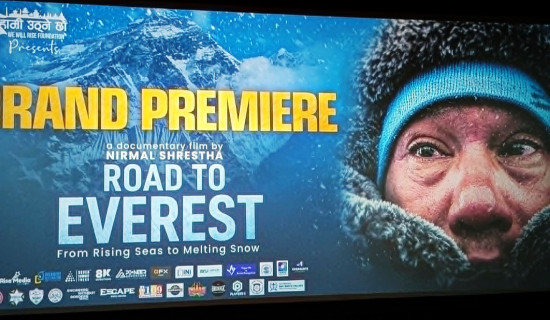
KATHMANDU:- The documentary ‘Road to Everest’—created to introduce Nepal to the international community by offering a vivid experience of scaling Mount Everest, the world’s highest peak—appears destined to serve as a timeless document and a gift to future generations for centuries to come.
Speakers and audience members at the premiere screening of the documentary in the capital have perceived it not merely as a story about the Himalayas, but as a narrative of Nepali identity. Produced through Nepali vision, investment, and technical expertise, this 50-minute documentary vividly portrays the indomitable courage of Nepali mountaineers, the impact of climate change on the Himalayan region, and the state of mountaineering in Nepal.
A documentary has been produced under the direction of journalist Nirmal Shrestha, incorporating videos and photographs captured by Raj Gurung during his ascent of Mount Everest—a climb undertaken with the assistance of Phurba Tenzing Sherpa (who has summited Everest 18 times) and Nima Gyaljen Sherpa (who has summited Everest 10 times and climbed all 14 peaks exceeding 8,000 meters).
While launching the documentary in the presence of various mountaineers, artists, media personnel, and officials from the Non-Resident Nepali Association (NRNA), Tulsi Kumar Gurung—Chairperson of the ‘We Will Rise Foundation’—urged everyone to help widely promote and take the documentary abroad; the film centers on Mount Everest, a key symbol of Nepal’s identity. The Foundation produced the documentary, having been established during the ‘Gorkha Earthquake’ with the resolve that ‘we can rise.’
The documentary presents the experience of the journey from sea level to the summit of the highest peak, while also addressing the impact of climate change. It offers a look at the conditions faced by climbers—ranging from Everest Base Camp to Camp IV—as well as the challenges, the congestion of climbers, health issues, and even incidents of death.
At the launch event, it was suggested that the documentary based on Mount Everest would have been even better had it included aspects such as time spent at the camps during the ascent, recreational activities, religious rituals performed according to individual beliefs, dietary habits, and waste management practices.