ICE officer who shot Renee Good in Minneapolis has served decades in military and law enforcement

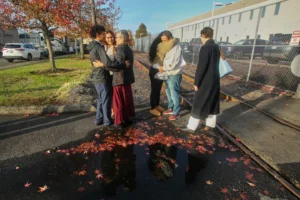
Federal officials have not named the officer who shot Good, a 37-year-old mother who was shot as she tried to drive away from federal agents. But Homeland Secretary Kristi Noem said the agent who shot Good had been dragged by a vehicle last June, and a department spokesperson confirmed Noem was referring to the Bloomington, Minnesota, case in which documents identified the injured officer as Ross.
Noem and other Trump administration officials have defended the agent as an experienced law enforcement professional who followed his training and shot Good after he believed she was trying to run him or other agents over with her vehicle. Video has raised questions about whether the shooting was in self-defense, and the FBI is investigating the deadly use of force. Some protesters are demanding that Ross face criminal charges, and Minnesota authorities also want to investigate.
Attempts to reach Ross, 43, at phone numbers and email addresses associated with him were not immediately successful.
Here are some things to know about him:
Experienced military and law enforcement officer
In courtroom testimony last month, Ross said he deployed to Iraq from 2004 to 2005 with the Indiana National Guard. Ross said he served as a machine gunner on a gun truck as part of a combat patrol team.
He said he returned from Iraq in 2005, went to college and joined the Border Patrol in 2007 near El Paso, Texas. He worked there until 2015, serving as a field intelligence agent gathering and analyzing information on cartels and drug and human smuggling.
Ross said he has served as a deportation officer based in Minnesota since he joined ICE in 2015. He is assigned to fugitive operations, seeking to arrest “higher value targets” in the ICE region that includes Minneapolis, he testified last month. He said that he was also a team leader with the FBI’s Joint Terrorism Task Force.
“So I develop the targets, create a target package, surveillance, and then develop a plan to execute the arrest warrant,” he said.
Ross said that he was also a firearms instructor, an active shooter instructor, a field intelligence officer and member of the SWAT team. He said that he attended the Border Patrol’s academy in New Mexico, where he learned to speak Spanish.
Seriously injured last June
FBI agents activated emergency sirens and lights instructing him to pull over but he did not. Ross pulled his vehicle diagonally in front of Munoz-Guatemala to force him to stop.
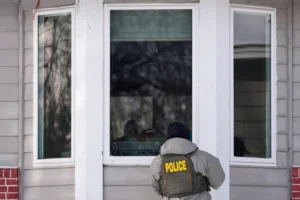
Ross and an FBI agent identified themselves as police and pointed guns at Munoz-Guatemala, who raised his hands. Ross then approached Munoz-Guatemala’s vehicle and ordered him to put it in park.
Ross told the driver to lower his window all the way down and warned that he would break it if he did not. Ross used a device known as a “spring-loaded window punch” to break the rear driver’s side window and reached inside the car to unlock the driver’s door.
Munoz-Guatemela drove off while Ross’ arm was caught in the vehicle and accelerated, dragging Ross down the street. Ross fired his Taser, striking Munoz-Guatemala with prongs in the head, face and shoulder.
Munoz-Guatemela was not incapacitated by the Taser, prosecutors said, and kept driving, taking Ross the length of a football field in 12 seconds. Ross was knocked free from the vehicle by force after Munoz-Guatemala drove onto a curb for a second time and back to the street.
Ross’ right arm was bleeding, and an FBI agent applied a tourniquet. Eventually, he received dozens of stitches at a hospital. Prosecutors said he had “suffered multiple large cuts, and abrasions to his knee, elbow, and face.”
“It was pretty excruciating pain,” Ross testified.
Munoz-Guatemela was bleeding from his injuries and had a woman call 911, saying that he was assaulted and didn’t know whether the person trying to stop him was an officer. He was arrested and charged with assault on a federal officer with a dangerous or deadly weapon.
A jury found Munoz-Guatemala guilty at a trial last month, finding he “should reasonably have known that Jonathan Ross was a law enforcement officer and not a private citizen attempting to assault him.”
Federal officials defend the agent without identifying him
“This is a guy who’s actually done a very, very important job for the United States of America,” Vance said. “He’s been assaulted. He’s been attacked. He’s been injured because of it.”
DHS assistant Tricia McLaughlin declined to confirm the agent’s identity Thursday, saying doing so would be dangerous for the safety of him and his family. But she noted that he had been selected for ICE’s special response team, which includes a 30-hour tryout and additional training on specialized skills such as breaching techniques, perimeter control, hostage rescue and firearms.
“He acted according to his training,” she said. “This officer is a longtime ICE officer who has been serving his country his entire life.”