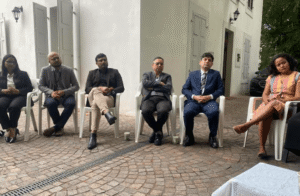
Dr. Karki urges the international community to provide additional financial support to Nepal
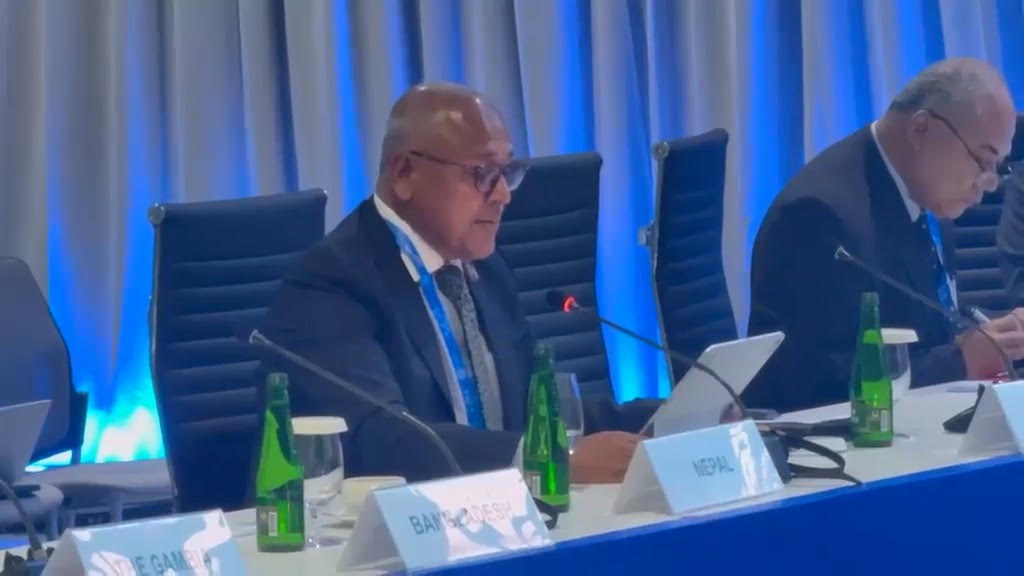
BANGKOK:- Dr. Arjun Karki, a federal parliamentarian from Nepal, has urged the international community to provide predictable, grant-based financial support to Nepal for mitigating the impacts of climate change, enhancing disaster resilience, and recovering from climate-induced loss and damage.
Addressing an event of the Climate Vulnerable Forum–Vulnerable Twenty Group (CVF-V20) held in Bangkok on the sidelines of the World Bank and International Monetary Fund (IMF) annual meetings on Thursday, Dr. Karki emphasized the need to address immediate financial requirements following climate-induced disasters, while also ensuring sustainable financial resources for long-term climate resilience and reconstruction.
Dr. Karki, a former Nepali Ambassador to the United States and former Global Coordinator of LDC Watch (a network of non-governmental organizations in Least Developed Countries), noted that developing nations are simultaneously grappling with the pressures of debt, climate-induced disasters, limited public financial resources, and mounting development needs. He stated that in countries like Nepal, the lack of climate finance—compounded by the failure to deliver pledged support in a timely manner—leads to severe losses in terms of lives, property, and livelihoods.
“If the necessary support for risk reduction—before a disaster strikes—and for recovery—afterward—arrives years too late, it cannot be used to rebuild a collapsed bridge, stabilize a hazardous landslide site, or keep remote communities safe before the next disaster occurs,” he said.
Noting that the floods in the Bhote Koshi–Trishuli region on August 26 claimed over 1,400 lives, left thousands missing, and caused extensive damage to settlements and critical infrastructure, he stated that officials estimate approximately 5 billion US dollars will be required for Nepal’s recovery. Furthermore, he recalled that floods in the Budhi Gandaki River a few days earlier also resulted in the loss of life and caused damage to homes, livelihoods, and rural infrastructure.
According to Dr. Karki, the impact of climate-induced disasters is not limited to human casualties alone. There are risks that damage to hydropower projects could weaken electricity generation and export capacity; the obstruction of roads and trade routes could disrupt commerce; and a decline in tourism could reduce foreign currency earnings. Furthermore, he noted that since fuel, machinery, and construction materials must be imported for reconstruction, such disasters could also place severe strain on the government budget, trade, and the balance of payments.
He remarked that the ‘Lifeline’ proposal—put forward with the aim of providing necessary liquid financial resources to affected nations before climate-induced disasters escalate into widespread economic crises—is significant. In the context of Nepal, he emphasized that the Parliament should formulate a financial strategy that accounts for climate risks and addresses the transitional phase associated with graduating from the status of a Least Developed Country (LDC).
He stated that such a strategy must clearly address issues such as potential changes in the nature of assistance following graduation, the financial terms applicable before and after graduation, the impact of recent disasters on Nepal’s external financing requirements, and how to bridge any projected gaps in financial resources.
He presented the ‘Vulnerability to Viability Compact’ as an important initiative for moving forward in this direction. He suggested that the eligibility criteria, costs, and debt repayment periods for financial assistance should be determined by taking into account the respective country’s climate risks, its exposure to disaster risks, and the expected lifespan of the investments.
“Hospitals, water supply systems, or climate-resilient roads are built with the intention that they will be used for generations. The terms of financial assistance obtained for such infrastructure should not create an unbearable immediate strain on the national budget,” he said.
Stating that the role of Parliament is crucial in ensuring Nepal’s national interests during international financial negotiations, Dr. Karki emphasized that the Ministries of Finance, Environment, and Foreign Affairs should present a coordinated national position to the relevant parliamentary committees prior to key discussions with the World Bank, the IMF, and development finance institutions.
He proposed that the relevant ministries should jointly inform the Parliament about what Nepal had requested following such meetings and negotiations, what achievements were realized, and which issues still remain to be addressed. He clarified that this would establish a clear link between international negotiations, national priorities, and budget allocation.
He also emphasized the need to ensure the meaningful participation of provincial and local governments, indigenous communities, women, and residents of the Himalayan region in the decision-making process regarding climate finance. He noted that the experiences and priorities of local communities are crucial for the effective utilization of limited resources.
He also proposed that parliamentarians affiliated with the CVF-V20 network should organize annual hearings to review the availability, distribution, and financial terms of climate finance. He noted that by sharing the findings from these reviews among member nations, countries that are currently in the process of graduation—or have already graduated—could develop a common parliamentary position on climate-risk-based financial support.
Dr. Karki stated that grant-based financial support for adaptation and addressing climate-induced loss and damage is a matter of justice, not charity. However, he emphasized that to ensure climate justice, the concerned nations must also develop the capacity to define their own priorities, strengthen their institutional capabilities, and collaborate with partners willing to provide support on equitable terms.
Dr. Karki expressed his commitment to advancing the agenda of the CVF-V20 in various forums—including Nepal’s parliament and international platforms such as the UN Climate Change Conference (COP)—while also emphasizing the need to protect and promote Nepal’s development achievements, taking into account the reality of the climate crisis.