
Bhairav Kund in Rasuwa, surrounded by religious faith and legend
A unique ancestral tradition of the Gole clan—part of the Tamang community—is also linked to Bhairavkunda. According to ancestral lore, a shaman (jhankri) of the Gole clan once arrived in the Gosainkunda region, accompanied by his wife. With the intention of subduing a venomous serpent (naga) residing within Bhairavkunda, he instructed his wife to continuously play the *dhyangro* (shamanic drum) and scatter *akshata* (sacred grains) for as long as he remained inside the lake. He then entered the lake to confront the serpent.
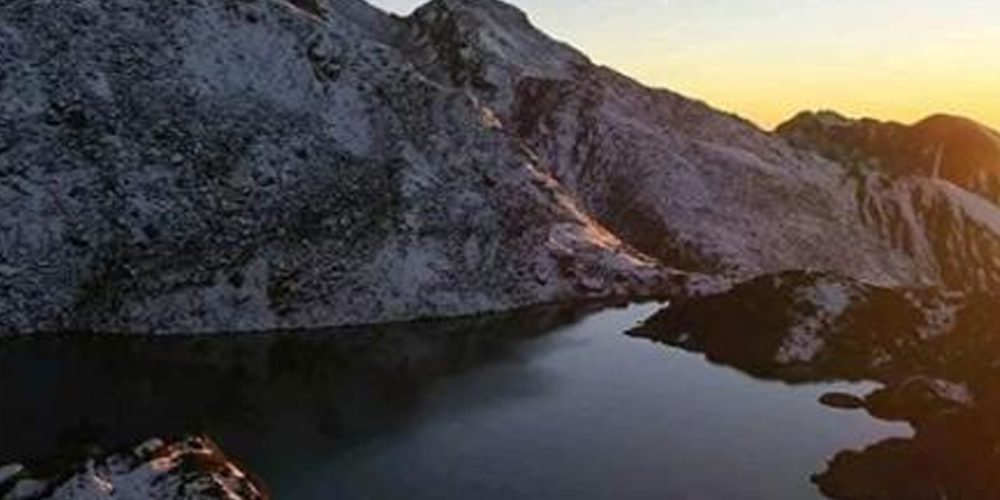
By Saraswoti, Neupane, RASUWA:- Located in the Gosaikunda region of Rasuwa, Bhairavkunda is a pilgrimage site that holds a distinct identity, shaped by religious beliefs, legends, and folk traditions that set it apart from other *kundas* (sacred lakes). Among the dozens of lakes and ponds—both large and small—found in the Gosaikunda area, Bhairavkunda is perceived as a site associated with fear and prohibitions.
Bhairavkunda is situated below the main Gosaikunda (Chhokar)—located in the high Himalayan region—and above Saraswatikunda (Wanglatti). The local Tamang community refers to it as ‘Chhona,’ meaning ‘Black Lake’ (Kalokunda).
Gosainkunda is regarded as a symbol of purity, life, and blessings, whereas Bhairavkunda is perceived as a symbol of fear and prohibition. Due to this religious belief, pilgrims visiting Gosainkunda do not bathe in Bhairavkunda. There is also a popular belief that one should not even look toward Bhairavkunda while returning from the circumambulation of Gosainkunda.
According to Dolma Yangjen Tamang, the Acting Ward Chairperson of Gosainkunda Rural Municipality-5, there is a tradition where pilgrims who bathe with devotion at Gosainkunda move on without even looking at—let alone bathing in—Bhairavkunda. She stated that the Ward Office has planned to construct a safe trail and install information boards to inform visitors about this tradition and help preserve it.
Various mythological tales and folk traditions from both Hinduism and Buddhism are associated with the origin of Bhairavkunda. According to Hindu religious belief, in the Satya Yuga, after Lord Shiva severed the head of Brahma, He created this pond—situated below Gosaikunda—to absolve Himself of the resulting sin and to find relief from physical suffering, and He performed penance here.
According to another account, Mahadev consumed the poison that emerged during the churning of the ocean by the gods and demons, in order to protect creation. It is believed that Bhairavkunda was formed from the sweat that flowed from Mahadev’s body as he struggled to endure the burning sensation of the poison lodged in his throat. Due to the belief that the pond originated from this toxic sweat, it is widely held that venomous serpents reside there and that its water is impure.
According to folklore associated with Buddhism, Bhairavkunda was created by ‘Chhona,’ the elder brother of Mahadev. As noted in the book *Religion and Culture in Biodiversity Conservation and Tourism Development*—authored by Rasuwa-based writer Phurpa Tamang—the two brothers had set out in search of a pristine place to live; however, upon finding a suitable location, the elder brother, Chhona, forgot about his younger brother. It is said that Mahadev, angered by his brother’s conduct, cursed him, declaring, “Since your heart has turned dark, may the pond you have created also be dark.”
The book mentions a popular belief that, due to this very curse, the pond created by Chhona came to be known as ‘Kalokunda’ (Black Pond)—or Bhairavkunda—while the one created by Mahadev became known as ‘Setokunda’ (White Pond)—or Gosainkunda.
According to local resident and Lama Guru Rinjen Ghale of Dhunche, in Buddhist and Tamang traditions, Gosaikunda is understood as ‘Chokar’—meaning a pure, white lake—while Bhairavkunda is known as ‘Chona,’ or a black lake. He explains that, due to the religious belief that Bhairavkunda embodies the energy of wrath and dissolution, bathing there—and even looking back at it—is strictly prohibited. He further notes that such beliefs reflect a sense of discipline regarding both nature and religious faith.
A unique ancestral tradition of the Gole clan—part of the Tamang community—is also linked to Bhairavkunda. According to ancestral lore, a shaman (jhankri) of the Gole clan once arrived in the Gosainkunda region, accompanied by his wife. With the intention of subduing a venomous serpent (naga) residing within Bhairavkunda, he instructed his wife to continuously play the *dhyangro* (shamanic drum) and scatter *akshata* (sacred grains) for as long as he remained inside the lake. He then entered the lake to confront the serpent.
Legend has it that after a long struggle, just as the *jhankri* (shaman) was about to emerge to the surface having defeated the *naga* (serpent deity), his wife became terrified upon seeing the dreadful state of the *kunda* (sacred pond). She stopped playing the *dhyangro* (shamanic drum) and scattering *akshata* (sacred grains) and fled the scene; consequently, the *jhankri*’s power waned, and the *naga* coiled around him, taking his life. It is widely believed that, due to this incident, people bearing the surname ‘Gole’ maintain a tradition to this day of not visiting Bhairavkunda—and, in some instances, even Gosaikunda.
According to Babulal Tamang, president of the Civil Society Rasuwa, people of the Gole clan still maintain the tradition of not visiting Bhairav Kund, following their ancestral traditions. He said that if such oral history, religious beliefs and intangible cultural heritage can be documented and preserved, a new dimension will be added to the promotion of religious and educational tourism in Rasuwa.