‘Women’s participation must not be limited to mere numbers; it needs to be elevated to decision-making levels’
Rastriya Prajatantra Party MP Khusbu Oli stated that although Nepal's Constitution ensures 33 percent women's participation, fostering effective leadership remains challenging. Noting the persistent influence of men over women elected at the local level, she expressed the view that "token representation" must come to an end. She also emphasized the need to make women economically self-reliant.
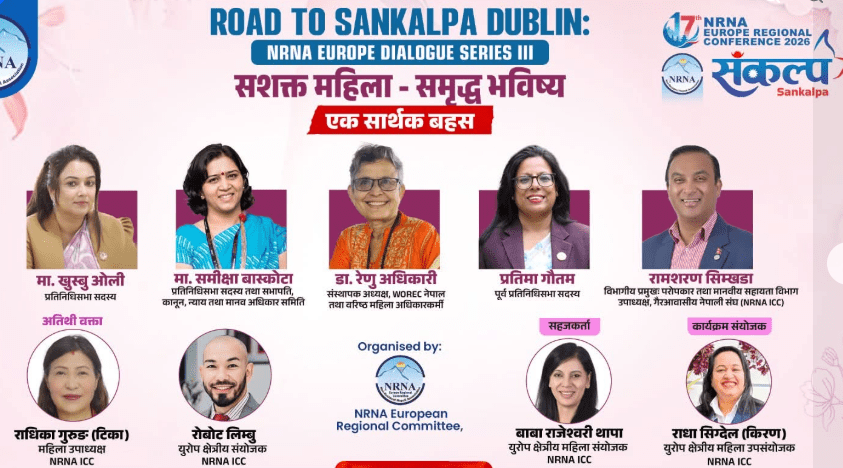
LONDON:- The Non-Resident Nepali Association (NRNA) Europe Region has organized a virtual dialogue on the theme “Empowered Women, Prosperous Future.” Speakers at the event emphasized the need to move beyond merely counting the number of women participating and instead ensure their involvement at the decision-making level.
Participants shared a common view that women’s empowerment must transcend mere numerical participation and extend to the levels of policy formulation and decision-making.
The Non-Resident Nepali Association (NRNA) Europe Region organized a virtual dialogue on the theme “Empowered Women, Prosperous Future”—as part of the “Road to Sankalpa Dublin: NRNA Europe Dialogue Series-3″—in preparation for the 17th Europe Regional Conference scheduled to be held in Dublin, Ireland, on August 10 and 11.
At the event, Nepali lawmakers, former parliamentarians, women’s rights activists, and activists from the diaspora shared their views on women’s leadership, policymaking, economic empowerment, citizenship, voting rights, and the challenges faced by women abroad, emphasizing the need to move beyond merely counting numbers and ensure women’s participation at the decision-making level.
Delivering the welcome address at the event, Radha Sigdel Kiran, the Women’s Deputy Coordinator for the NRNA Europe region, stated that women’s empowerment is the foundation for building a prosperous society. Europe Coordinator Robert Limbu, who chaired the session, expressed his belief that the dialogue would be useful in making the women’s agenda more effective for the Dublin conference.
Keynote speaker and Rastriya Prajatantra Party MP Khusbu Oli stated that although Nepal’s Constitution ensures 33 percent women’s participation, fostering effective leadership remains challenging. Noting the persistent influence of men over women elected at the local level, she expressed the view that “token representation” must come to an end. She also emphasized the need to make women economically self-reliant.
Samiksha Baskota, a lawmaker from the Rastriya Swatantra Party and Chairperson of the House of Representatives’ Committee on Law, Justice, and Human Rights, stated that women’s empowerment must begin with decision-making processes within the home. She shared her views on economic self-reliance, decision-making rights regarding property, digital abuse targeting women in leadership, and increasing women’s participation in politics. She also emphasized that men, too, should speak openly about issues concerning women’s rights.
Nepali Congress Central Member and former MP Pratima Gautam pointed out that constitutional and legal provisions have not been effectively implemented, noting that women in remote villages remain deprived of basic healthcare, economic opportunities, and social justice. She suggested that Nepalis living abroad should play a role in bringing the experience of gender equality from developed nations back to Nepal.
Dr. Renu Adhikari, a women’s rights activist and founder of OREC Nepal, stated that Nepali women who have migrated to countries such as Italy and Portugal have faced human trafficking, domestic violence, and various forms of exploitation. She highlighted the need for the NRNA to formulate a clear action plan and establish a dedicated mechanism for women to address these issues.
Ramsharan Simkhada, Vice-Chair of the NRNA International Coordination Council, stated that the NRNA is engaging with the government and parliament to secure Non-Resident Nepali (NRN) citizenship, the continuity of citizenship by descent, and voting rights for Nepalis living abroad. He also noted the need for structural reforms to enhance women’s participation and leadership within the organization.
Parashuram Bhandari and Kunti Thapa, who participated in the program from the United States, raised questions regarding citizenship, the rights of the Nepali diaspora, and other contemporary issues. The discussion also covered topics such as the issue of squatters, the challenges faced by women in foreign employment, and digital KYC.
The organizers stated that the interactive session, which lasted approximately two and a half hours, laid the groundwork for drafting the ‘Dublin Declaration’ to be presented at the Dublin Conference. In their concluding remarks, participants shared a common view that women’s empowerment must move beyond mere numerical participation to reach the levels of policy formulation and decision-making.