Tourist traffic increasing in Gosainkunda after floods
Located within the Langtang National Park area in Ward No. 6 of Gosaikunda Rural Municipality, Gosaikunda sits at an altitude of 4,380 meters above sea level. Spanning an area of approximately 13.80 hectares, the lake measures 625.55 meters in length, 302 meters in width, and 26 meters in depth. It is estimated that the lake contains approximately 1.472 million cubic meters of water.
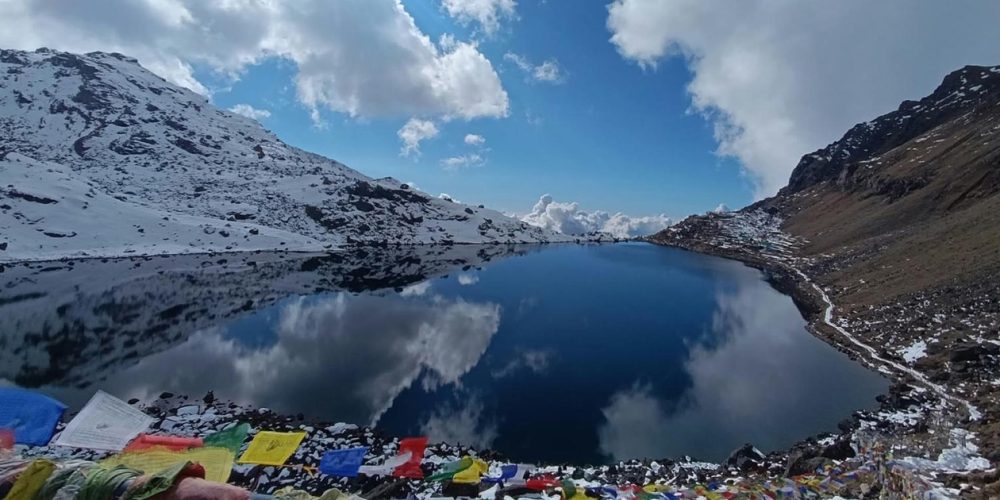
By Saraswoti Neupane, RASUWA:-The arrival of both domestic and international tourists has begun to pick up once again at Gosaikunda—a renowned pilgrimage site in Rasuwa, rich in religious significance, natural beauty, and biodiversity. The tourism sector, which had slowed down after the floods in the Bhote Koshi River on the 10th of Bhadra damaged roads and trekking trails, is now gradually returning to its normal rhythm as accessibility improves.
Kaisang Nurpu Tamang, Chairperson of Gosainkunda Rural Municipality, stated that the tourism sector, which had been affected by floods, has begun to revive. According to him, the increase in tourist arrivals has brought relief to hotel owners, trekking guides, transport workers, and other small-scale business operators.
“Following the floods, tourism activities had come to a near-complete standstill. Now, as road conditions improve, both domestic and international tourists have begun to arrive,” said Chairperson Tamang. He noted that the Rural Municipality is carrying out maintenance on trekking trails and coordinating efforts to ensure the safety and convenience of tourists.
Ganesh Prasad Tiwari, Information Officer and Conservation Officer at Langtang National Park, stated that tourist arrivals in the Gosaikunda area have resumed as normal, following the restoration of access routes that had been obstructed by floods. He further noted that the National Park has been implementing programs aimed at conserving the natural environment and biodiversity of the region.
Babulal Tamang, Chairperson of Civil Society Rasuwa, stated that the number of pilgrims and trekkers visiting Gosaikunda has begun to rise as the condition of roads and trekking trails has improved. He noted that tourism activities were affected for some time after floods caused damage to the routes.
According to local hotelier Santosh Ghale, the number of domestic tourists—particularly from the younger generation—visiting Gosaikunda has been on the rise. He noted that while, in the past, a significant influx of pilgrims occurred primarily during Janai Purnima and Ganga Dashahara, trekkers and leisure travelers can now be seen visiting throughout much of the year.
According to entrepreneur Ghale, if attention is paid to the sustainable upgrading of trekking trails, communication facilities, and the development of basic infrastructure, tourism in this region can contribute to both the livelihoods of local people and the national economy.
Located within the Langtang National Park area in Ward No. 6 of Gosaikunda Rural Municipality, Gosaikunda sits at an altitude of 4,380 meters above sea level. Spanning an area of approximately 13.80 hectares, the lake measures 625.55 meters in length, 302 meters in width, and 26 meters in depth. It is estimated that the lake contains approximately 1.472 million cubic meters of water.
Gosainkunda, a shared center of faith for both Hindus and Buddhists, has held religious significance since ancient times. According to Hindu scriptures, it is believed that after Lord Shiva consumed the deadly poison *Kalkuta*—which emerged during the churning of the ocean (*Samudra Manthan*)—he struck the rocky cliff with his *trishul* (trident) to quench the burning sensation caused by the poison. Water gushed forth from the opening, forming the *kunda* (sacred pond). Because the water is believed to have emerged from the strike of the *trishul*, this region is also associated with *Trishuldhara* (the stream of the trident).
In the local community, Gosaikunda is known by various names. The Tamang community refers to it as ‘Gyo’ or ‘Chhokar’, the Sherpa community as ‘Ghyo’, the Tibetan community as ‘Cho’, and the Newar community as ‘Shilu’.
Surrounding Gosaikunda are several other *kunds* (lakes/ponds), including Bhairavkunda, Saraswatikunda, Suryakunda, Chandrakunda, Dudhkunda, and Ganeshkunda. The historic Amarsingh Cave, located in this region, along with the unique culture of the local Tamang community, also serve as attractions for tourists.
Considering its ecological significance, the Gosainkunda area was listed as a Ramsar site on September 23, 2007 (Ashoj 5, 2064 BS). It is home to wildlife such as the snow leopard, red panda, musk deer, and Himalayan tahr, as well as flora including rhododendrons, orchids, and other Himalayan plant species.
Gosaikunda is well-known as a major religious and tourist destination in Nepal. This area also connects the Helambu, Langtang, and Tamang Heritage trails. Large fairs are held here, particularly during Ganga Dashahara (falling in Jestha–Asar) and Janai Purnima (falling in Saun–Bhadau). Tanka Prasad Dhakal, a priest from Rasuwa, mentioned that special religious rituals also take place during Bala Chaturdashi. RSS