Chhath Puja is performed by offering Arghya to the setting sun
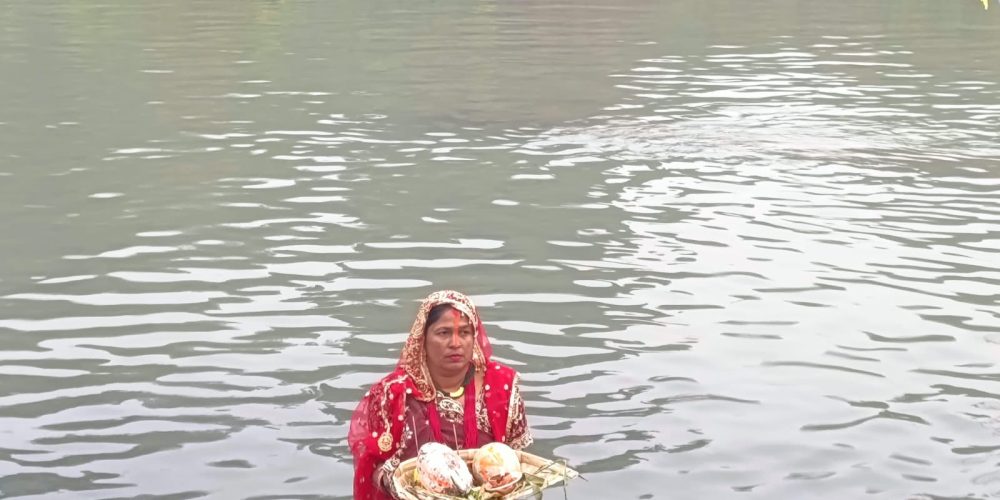
SUNSARI:- Across the country, including in Sunsari, the festival of Chhath was marked this Sunday evening with the offering of *arghya* (ritual oblations) to the setting sun.
On the occasion of Chhath, songs extolling the Sun God and Goddess Shashthi (Chhathi) can be heard echoing everywhere—from Inaruwa, Itahari, Duhabi, Gadhi, and Barju in Sunsari to the canals of the Sunsari-Morang Irrigation Project.
The festive spirit of Chhath has intensified across the district, with locals busy preparing—constructing artificial ponds in front of their homes or setting up *Chhath ghats* (ritual sites) along existing water bodies.
Today marks the third day of Chhath—the main day of the festival. On this day, those observing the fast remain completely abstinent, not even consuming water. In the evening, they head to nearby water bodies—such as ponds, lakes, or wells—and, while immersed in the water, offer worship to the setting sun. The *ghats* where the sun is worshipped have been decorated as elaborately as a bride.
People across this region appear to be fully engaged in preparations for Chhath, the grand festival dedicated to the worship of the Sun. Devotees commenced the festival on Friday with the ‘Nahay-Khay’ ritual. The ‘Nahay-Khay’ ritual is performed on the fourth day of the bright fortnight (Shukla Chaturthi) of the month of Kartik.
On the third day of the bright fortnight of the month of Kartik, observers begin the festival through a ritual known as ‘Arba-Arbain’ by abstaining from *tamsi* (tamasic) and *rajsi* (rajasic) foods—such as parboiled rice, finger millet (*kodo*), lentils (*musuro*), fish, and meat.
Sarita Devi Yadav, a devotee from Duhabi in Sunsari, noted that although the scriptures allow both men and women to observe the fast, it is typically the primary woman of the household who undertakes the vow.
The festival has brought a flurry of activity to every household. In this observance—which places immense value on devotion, dedication, and spiritual purification—the ritual offerings (*prasad*) are prepared using rice and wheat flour that have been pounded or ground using traditional implements like the *dhiki* (treadle-operated husking lever) and *janto* (hand-operated millstone). These offerings include *thakuwa* (a special delicacy made from wheat flour and jaggery, fried in pure *ghee*), *bhusuwa* (also known as *kasar*), and various other sweet treats.
A new hearth is also used to cook these dishes. Since items such as *jamir* (a type of citron), *bimiro* (citron), ginger plants (uprooted with the stalk intact), turmeric, and sugarcane (complete with its leafy top) are essential for the rituals—specifically for offering *arghya* to the Sun and performing the *hath uthaune* (raising hands) rite—these agricultural products see a strong market demand during this festival.
In the Mithila region, devotees observing the *Chhath* fast will offer *arghya* to the setting Sun this Sunday, followed by the *paran* (the concluding ritual, involving an offering to the rising Sun) on Monday morning.