India’s influence in Nepal: NPR traded in Indian markets, but there is a scam in the exchange rate
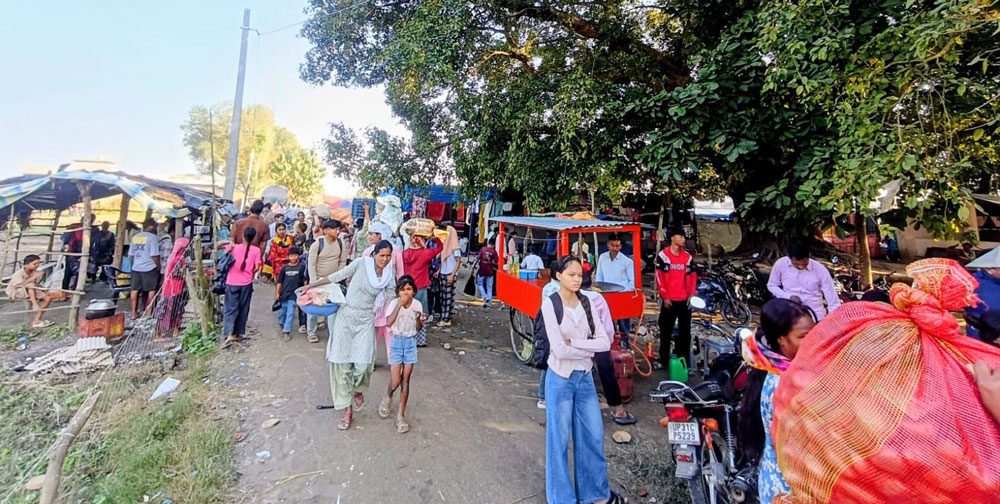
At the shops in the Indian border village of Belaparsua and at the 'Turni Bazaar' held every Sunday at Garhibaba, Nepalis from the border villages not only face various hardships but are also frequently subjected to exploitation and robbery.
DHANGAHDI:- It might seem hard to believe that Nepali currency is not accepted within Nepal itself, but there is a village in Kailali where transactions are conducted exclusively in Indian Rupees (INR), rather than Nepali currency.
In Hausalpur—a border village located in Kailari Rural Municipality-7—transactions have long been carried out using Indian Rupees. This practice exists because the local economy is more closely linked to India than to the rest of Nepal, and the village relies heavily on India.
Whether purchasing goods at local grocery stores or dining at restaurants, residents and visitors must make payments in Indian Rupees.
Locals themselves acknowledge that it is unfortunate to devalue their own national currency; however, they frequently opt to use Indian currency instead. This is driven by the belief that Indian traders prefer transactions in their own currency—which facilitates business—and the hope that using Indian notes will make trade more convenient.
In the past, the village of Hausalpur, located across the Mohana River, was quite isolated. Since the construction of a suspension bridge over the river, however, movement has become easier, and various types of transactions have been greatly facilitated.
Residents from neighboring villages—located on this side of the Mohana River—frequently visit this village to purchase items ranging from potato and wheat seeds to various daily necessities. It is reported that the goods sold here are predominantly of Indian origin.
Exploitation in Indian Markets
For Nepalis—who are compelled to conduct transactions using Indian currency even within their own country—Indian markets across the border can hardly be considered a convenient or favorable option.
At the shops in the Indian border village of Belaparsua and at the ‘Turni Bazaar’ held every Sunday at Garhibaba, Nepalis from the border villages not only face various hardships but are also frequently subjected to exploitation and robbery.
Attracted by rumors that goods can be purchased at lower prices, Nepalis from the border villages visit the Turni Bazaar every week—only to be exploited by Indians, who cheat them in matters ranging from currency exchange rates to the weighing of goods. While the Nepali rupee is accepted in Belaparsua and the Turni Bazaar, it is always at a disadvantageous exchange rate.
Indian traders conduct transactions by valuing 1,000 Nepali rupees at 600 Indian rupees, and 500 Nepali rupees at 300 Indian rupees.
Based on this practice, Nepalis trading in Indian markets along the border incur a loss of 40 rupees on every 1,000 Nepali rupees, and 20 rupees on every 500 Nepali rupees.
According to Dilip Chaudhary from Tighari in Kailari Rural Municipality-7, while there are no issues with using Nepali rupees in major Indian border markets—such as Bangawa, Suda, and Chandanchauki, located near Dhangadhi (the temporary headquarters of Sudurpaschim Province)—problems do exist in the Belaparsua and Turni markets.
In these specific markets alone, Indian traders have already swindled millions of rupees from Nepalis. Locals complain that Indian traders engage in dishonest practices, cheating Nepalis—who come in search of cheaper goods—not only on the currency exchange but also by manipulating the weight of the items sold.
This market has been operating for the past three years, specifically targeting Nepali customers for their daily consumer goods.
Local resident Ramlal Chaudhary, who has witnessed the situation firsthand, stated that traders at the ‘Turni’ market—where substandard or often decaying goods are sold—frequently engage in significant cheating regarding the weight of items.
When goods are weighed using scales, the actual weight is often 200 to 300 grams short per kilogram.