
Mount Api : Where Nature Speaks with a Smile
The Api Nampa Conservation Area serves as a sanctuary for rare wildlife and flora. Species such as the red panda, snow leopard, musk deer, and the Danphe (Himalayan monal) are found here, alongside a variety of valuable medicinal herbs. Thapa notes that climate change, the unmanaged use of natural resources, and human activities have posed challenges to the continued existence of these natural assets.
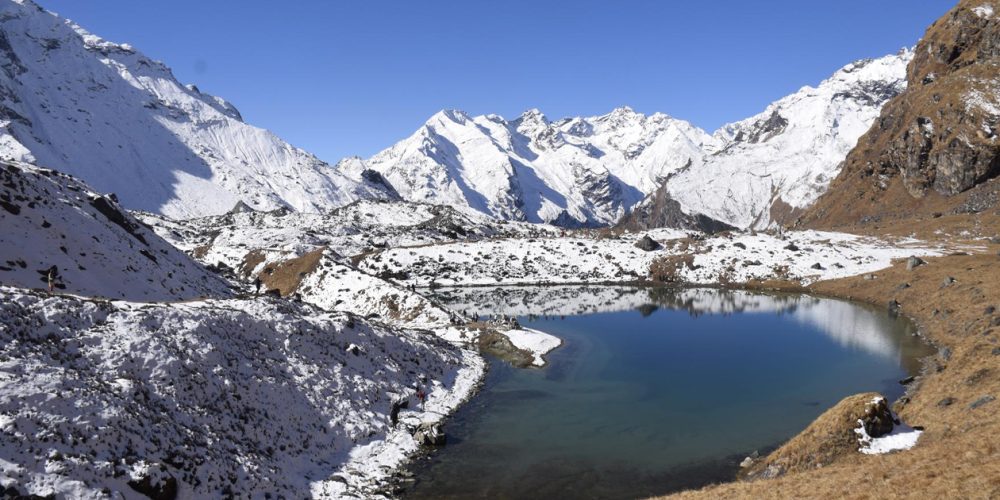
By Bhumiraj Pithatoli, BAJHANG:- Surrounded by mountains that glisten like silver, a vast highland plateau stretches out in the center. Streams emerge from the foothills of these peaks, feeding enchanting lakes. These unique natural features transform the Api Himal Base Camp area in Darchula into a beautiful slice of heaven. Encircled by the Api, Nampa, Kapuchuli, and Babai mountains, this landscape resonates with the silent music of nature for every visitor.
Mount Api, the highest peak in the Far-Western region—standing at an elevation of 7,132 meters above sea level—is the primary attraction of this area. From the base camp, situated at an altitude of 3,900 meters, one can observe the magnificent mountain ranges from a close vantage point. Vast alpine meadows, blue lakes, streams originating from glaciers, and rare flora further enhance the beauty of this region.
Reaching this place is an exciting journey in itself. After traveling by jeep through Marma Rural Municipality to Makarigad, one must undertake a trek lasting approximately two days. As travelers navigate steep ascents, rugged trails, and the banks of rivers, they encounter the diverse landscapes of the Himalayan region. Upon finally arriving at the base camp after the long trek, the fatigue of the journey vanishes amidst the captivating mountain scenery.
Kalidhunga, Bayeli Lake, Dharmi and Markandeya Caves, the source of the Chameliya River, and expansive highland pastures are the key attractions of this region. Alongside its natural heritage, sites of religious, cultural, and historical significance further enhance its tourism potential.
Covered in colorful flowers during the summer, these highland pastures (*patan*) are significant not only for tourists but also for the livelihoods of the local people. Valuable medicinal herbs—such as Yarsagumba, Panchaule, Padamchal, Hatwajadi, Bayujadi, and Jatamansi—are collected here. Furthermore, this region is well-known as a traditional grazing ground for sheep, mountain goats (*chyangra*), and *chauri* (yaks/yak-cow hybrids).
Bhaktasingh Thekare Bohara, Chairperson of Api Himal Rural Municipality, plans to develop this region into a strong foundation for a modern tourism-based economy. He believes that increasing tourism activities will create employment and income opportunities at the local level.
He stated that preparations are underway to increase local participation in community-based homestays, local transportation, trekking guide services, porter services, as well as the hotel and food service sectors. The necessary personnel have undergone repeated training for this purpose. “We have prepared many individuals from the municipality by providing training across various sectors, focusing on the role of locals in expanding the tourism economy,” said Chairperson Bohara.
The Rural Municipality aims to attract 10,000 domestic and international tourists to the base camp area in the current fiscal year. “Based on current preparations, we are confident that the expected number of tourists will arrive,” he said.
According to Bohara, the main challenge at present lies with the communication network and internet connectivity. He claims that other infrastructure is already in place. “The unique character of the local people is a great asset. Visiting tourists will not face any difficulties. We have completed the necessary work to meet current requirements, and further infrastructure will be added as needed,” he said.
The identity of Api Himal is not limited to its natural beauty alone; its local attire, customs, folk musical instruments, *Deuda* (a traditional dance and song form), and traditional knowledge are equally significant. Mahadev Dhami, the operator of Gaira Eco Resort in Ghusa, states that they are actively engaged in preserving local culture while extending hospitality to tourists. He notes that the training received from the Rural Municipality has made it much easier to manage guest meals, accommodation, and overall hospitality.
The Rural Municipality has arranged for the operation of homestays at various locations between Makarigad and the Base Camp. Accommodation facilities for tourists are available in Dhanbora, Ghusa, Nali, Lamamadau, Arukhor, Siti, Khayakot, Chhirchhire, Simar, Bhalyakhola, and Dhauli-odar. Furthermore, in the Base Camp area, permanent hotel facilities and large tents have been set up, capable of accommodating 70 guests daily. Those who choose to carry their own tents will also find the arrangements convenient.
Although the distance from Makarigad to the base camp is 34 kilometers, the presence of homestays—spaced just three to five kilometers apart—makes the journey much more convenient for travelers. Local authenticity and warm, personal hospitality are the hallmarks of the experience here. Guests are drawn in by the traditions practiced at every homestay: welcoming visitors with flower garlands, showcasing dances that reflect the local cultural identity, and serving authentic local cuisine.
Devaki Thami, Vice-Chair of Bigu Rural Municipality in Dolakha, praised the local hospitality. “Visitors are welcomed right from the start with garlands. Local dances are performed, showcasing the region’s cultural identity. In terms of accommodation and food, one does not feel the absence of a star-rated hotel. Even more delightful, however, are the speech and conduct of the local people. It is this very asset that brings tourists closer to Api Himal,” she remarked. Thami believes that by linking tourism with cultural preservation, the region’s unique identity can be passed on to the new generation.
According to Bisan Budhathoki, who oversees the Rural Municipality’s tourism department, the Rural Municipality is working on extending reliable communication services up to the base camp, arranging first-aid supplies, deploying trained personnel, and developing an emergency rescue system.
Api Himal also serves as a center of religious faith. There is a popular belief that the Chameliya River, which originates at its base, is a manifestation of the Ganga flowing from the head of Lord Shiva. According to Jhalaksingh Lothyal from Khayakot, the reverence for Surma Bhawani in Chhetti and Ghajir, the pilgrimage tradition associated with Surma Sarovar, and the presence of the Markandeya and Dharmi caves have enriched the religious identity of this region. He believes that the presence of Shiva at the summit has also added spiritual significance to the local temple. He noted that Api Himal is not merely a gift of nature, but also a symbol of faith.
Climate Crisis in the Lap of the Himalayas
Along with the beauty of Api Himal, concerns regarding its future are also growing. Due to climate change, the melting of snow and ice has accelerated. Water sources have begun to dry up. Shifts in rainfall patterns are starting to impact traditional livelihoods.
On one hand, there is an opportunity to place this region on the global tourism map. On the other, climate change is increasing risks to the Himalayan ecosystem and local livelihoods. Keeping this challenge in mind, the Rural Municipality has launched an initiative that combines tourism promotion with environmental conservation.
The Nepal Himalayas are known as the ‘Third Pole’ of the world. Its glaciers, glacial lakes, rivers, forests, grasslands, and wetlands sustain the lives of millions of people across South Asia. However, global temperature rise is causing glaciers to melt at an alarming rate, and the risk of glacial lake outbursts has increased. Problems such as the drying up of water sources, disruptions to agricultural systems, and a decline in biodiversity have already begun to emerge.
According to Dr. Rameshraj Pant, an environmentalist and assistant professor at Tribhuvan University, the impacts of climate change have begun to manifest in high-altitude Himalayan regions, such as the Api Himal area. He notes that changes in the timing and patterns of precipitation, irregular snowfall, and the drying up of water sources have affected the local way of life.
Its impact is not limited to the snow on the mountains; it has reached the kitchens, livestock sheds, and farmlands of the local people. He noted that the changing climate has become an additional challenge for families who depend on sheep and *chauri* (yak-cow hybrid) rearing, agriculture, and the collection of medicinal herbs.
According to Dr. Pant, the climate crisis does not affect everyone equally. Families with limited economic resources, women, children, the elderly, and persons with disabilities are at greater risk. He noted that Himalayan communities—who have contributed the least to climate change—are the ones facing the heaviest toll.
Chameliya Watershed: A Shared Responsibility for Conservation
Spanning an elevation range from approximately 700 to 7,000 meters (at Api Himal), the Chameliya watershed is significant in terms of its geographical and ecological diversity. According to environmentalist Dr. Pant, available studies indicate an average temperature ranging from 7 to 18 degrees Celsius, an annual rainfall of approximately 1,700 millimeters, and an average water flow of 177 cubic meters per second. He states that, as a result, climate change has impacted various sectors—including agricultural systems—in both upstream and downstream areas.
Research indicates that water quality is deteriorating in certain areas, including the Rithegad section, among the tributaries of the Chameliya River. Dr. Pant noted that a 2025 study suggests prioritizing the Chameliya watershed to effectively manage the upper and lower reaches of the Mahakali River.
These findings clarify that watershed conservation is not the sole responsibility of any single local government unit. Dr. Pant emphasized that a collaborative effort involving multiple local governments, the provincial government, and the federal government is essential.
There is a need for the integrated management of rivers, tributaries, water sources, forests, grazing lands, and biodiversity. Geologist Kamal Thapa suggests that it is essential to implement community-based water security programs, alongside the revitalization of drying water sources, groundwater recharge, and rainwater harvesting.
The Api Nampa Conservation Area serves as a sanctuary for rare wildlife and flora. Species such as the red panda, snow leopard, musk deer, and the Danphe (Himalayan monal) are found here, alongside a variety of valuable medicinal herbs. Thapa notes that climate change, the unmanaged use of natural resources, and human activities have posed challenges to the continued existence of these natural assets.
A Shared Commitment to Safeguard the Future of the Himalayas
Api Himal holds immense potential for tourism. Geologist Thapa states that if natural beauty, biodiversity, culture, and the Himalayan lifestyle can be systematically integrated with tourism, this region could become a significant destination in Nepal.
If nature is not preserved, the future of tourism cannot be secure either. Therefore, he holds the view that development should not be limited merely to roads, hotels, and the number of tourists. He states, “The conservation of the Himalayas, water resources, biodiversity, and the lifestyles of local communities must be placed at the heart of development.”
The climate dialogue initiated from the base camp has conveyed the message that the Himalayan crisis is not merely a problem for local communities. The impact felt in the Himalayas extends—via rivers—to human settlements, farmlands, and human life itself. Therefore, Thapa emphasized that collaboration, ranging from the local to the international level, is essential for its conservation.
A Call for Climate Justice Rising from the Himalayas
The ‘Api Himal Declaration-2083’ was issued during the Api Himal Tourism Festival and Climate Dialogue, organized by the Api Himal Rural Municipality in the base camp area. Its primary objective was to strengthen collaboration among the local governments along the Chameliya River corridor and to express a shared commitment toward the Himalayan environment, climate justice, and sustainable development.
The manifesto covers 17 topics, including biodiversity conservation, ecological restoration, sustainable use of natural resources, promotion of local knowledge and culture, climate-resilient livelihoods, sustainable tourism, and research and innovation.
This conveys the message that the challenges facing the Himalayan region are not confined solely within local boundaries. The declaration emphasizes the scientific and equitable utilization of forests, land, water, medicinal herbs, and grazing areas. It expresses a commitment to implementing climate adaptation programs by integrating traditional knowledge with modern science.
The objective is to expand opportunities in green employment, organic farming, herbal enterprises, and renewable energy, with a focus on women, youth, farmers, and marginalized communities.
Priority has also been given to making Himalayan trekking trails environmentally friendly, managing plastic and solid waste, preserving glaciers and lakes, and revitalizing water sources.