Nepal urges institutionalization of mountain areas and climate change issues
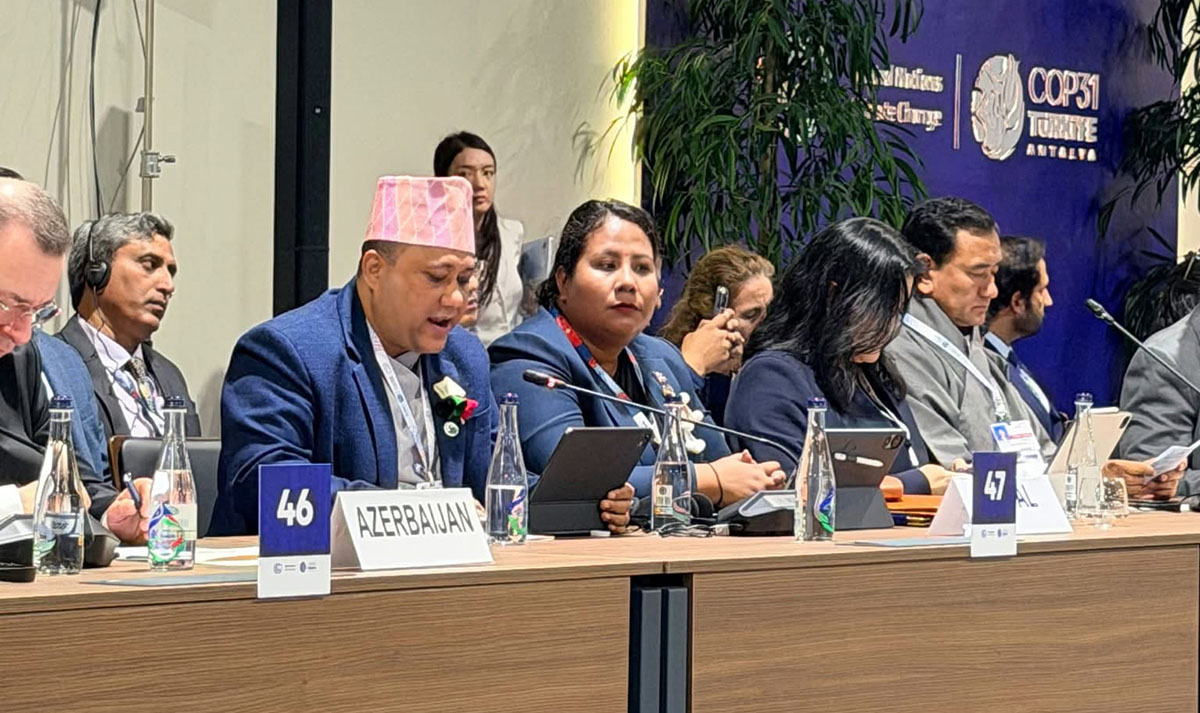
Antalya, Türkiye:- Nepal has urged that issues concerning mountain regions and climate change be established as a permanent and institutional agenda within the negotiations under the United Nations Framework Convention on Climate Change (UNFCCC).
Nepal has stated that a dedicated action plan, regular dialogue, and high-level political commitment are essential to address the escalating risks in mountain regions—such as disasters caused by glacial lake outbursts, loss of life and property, and impacts on ecosystems—resulting from climate change.
Presenting Nepal’s position at the high-level (presidential-level) consultation on mountain regions and climate change—held here in the context of COP-31—Dr. Maheshwar Dhakal, Joint Secretary at the Ministry of Agriculture, Forestry and Environment and Chief of the Climate Change Management Division, stated that the issues facing mountain regions must not remain confined merely to discussions.
Presenting a common position on behalf of Nepal and Bhutan, he noted that the demand for a separate agenda on mountain regions and climate change is not merely a theoretical matter, but rather a consequence of the serious humanitarian and environmental crises being faced by mountain nations.
Noting that the recent devastating glacial flood in Nepal’s Bhote Koshi region has caused extensive damage to human lives, livelihoods, and physical infrastructure, he stated that rising temperatures—along with the risk of global warming exceeding the 1.5°C threshold—have further exacerbated the crisis in mountain regions.
Noting that the issue of mountain regions is not new to international climate change negotiations, Dr. Dhakal informed that the first Global Stocktake concluded at COP-28 mandated an expert dialogue on mountain regions. This dialogue took place in 2024. He further mentioned that the COP-30 process has paved the way for organizing another such dialogue in 2026.
Noting that while these efforts are positive, they are insufficient to address the challenges faced by mountain regions, he emphasized the need for a structured, continuous, and results-oriented institutional process.
Nepal has proposed the implementation of a dedicated work programme focused on mountain regions and climate change. Nepal’s position is that this programme should encompass climate change mitigation, adaptation, loss and damage, and the means of implementation.
Similarly, to ensure continuity and concrete achievements regarding mountain-related issues, Nepal has proposed establishing an institutionalized annual dialogue, as well as organizing a high-level mountain dialogue to garner greater attention and commitment at the political level.
Nepal has also emphasized the need to expand scientific research and studies on the impacts of climate change on mountain ecosystems. Nepal has stated that further scientific study is required regarding the effects of rising temperatures—including the magnitude and duration of temperatures exceeding the 1.5°C threshold—and the resulting impacts on communities living in mountain and downstream areas.
Nepal has urged the international community to provide immediate and additional support—including financial resources, technology transfer, capacity building, early warning systems, and measures to address loss and damage—to mountainous countries that are at high risk from climate change.
Noting that the impacts of climate change in mountainous regions are not merely potential future risks but a reality already being observed today, Dr. Dhakal stated that these effects are not confined to mountainous areas alone but extend to other regions as well.
Pointing out that merely holding successive dialogues is insufficient given the escalating challenges in mountain regions, he emphasized the need for an institutional structure capable of translating scientific evidence and political commitments into immediate action and support.
Nepal has urged the COP31 presidency and all participating nations to ensure that the conference yields meaningful and concrete outcomes regarding mountain regions and climate change.
The shared position of Nepal and Bhutan prioritizes the climate risks faced by mountainous countries, their financial needs, and the institutional recognition of mountain-related issues within international climate negotiations.