Seven foreign tourists rescued after snowfall in Khumbu region
"We are on standby for necessary rescue and safety operations in coordination with the District Disaster Management Committee," he said. The administration has urged people to avoid unnecessary travel to high-altitude areas until weather conditions normalize and to comply with notices issued by local authorities and municipalities.
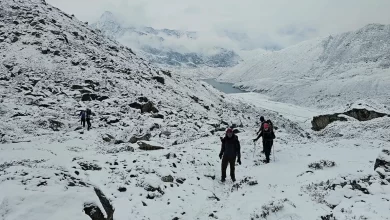
SOLUKHUMBU:- Heavy snowfall in the Khumbu region of Solukhumbu has disrupted the movement of tourists in the high-altitude areas. Snowfall began in the upper reaches of Khumbu following continuous rainfall.
According to Chief District Officer Kamansingh Thapa Magar, more than half a meter of snow has accumulated in the high-altitude areas of Khumbu. Due to the snowfall, tourists who had ventured into the upper regions for trekking and mountaineering have been barred from proceeding further toward hazardous areas.
He said, “Heavy snowfall is occurring in the upper regions. Reports indicate that snow accumulation has exceeded half a meter in some places. Prioritizing the safety of tourists, efforts are underway to move them to safe locations in coordination with local authorities, residents, and the police.”
Seven foreign tourists stranded in the Imja Tse (Island Peak) area of the Everest region due to heavy snowfall have been rescued. According to the Chief District Officer, Thapamagar, reports indicate that these tourists are European citizens of Chinese origin. They were brought to a safe location with the assistance of local representatives and residents after snowfall made movement in the higher altitudes difficult.
Imja Tse—also known as Island Peak—is a significant mountaineering destination in the Khumbu region, located within Sagarmatha National Park. According to the Nepal Tourism Board, the trekking route leading from Dingboche towards Chhukung via the Imja Khola connects to the main trekking trail of the Everest Base Camp area. Island Peak is known locally as Imja Tse.
This area is a mountaineering destination situated at an altitude of approximately 6,165 meters above sea level within the Khumbu mountain region; it is officially recorded in the Government of Nepal’s tourism statistics.
Coordination has been established with local authorities and security agencies to prevent additional tourists and trekkers from proceeding to the higher reaches due to adverse weather conditions.
According to the administration, there are currently more than 1,200 tourists in the Everest region. The administration stated that it is continuously gathering information about their status through local authorities, the police, and other relevant agencies.
According to Laxman Adhikari, Ward Chairperson of Khumbu Pasang Lhamu Rural Municipality-4, the rural municipality has issued a notice advising tourists and trekkers to exercise caution due to adverse weather conditions. “We have prioritized the safety of tourists given the unfavorable weather. We have urged them not to venture to higher altitudes unnecessarily under risky conditions,” he said.
According to Sagarmatha National Park, the Khumbu region is a high-risk geographical area within the Himalayan ecosystem. The upper reaches of the park feature glaciers, mountain peaks, and deep valleys. The Imja Khola system is also part of the park’s significant watershed area.
The Nepal Tourism Board characterizes the Everest region as an area prone to rapid weather fluctuations due to its high-altitude mountainous terrain. Since low temperatures and precipitation—including both rain and snowfall—can affect trekking and mountaineering activities in the upper reaches, it is essential to plan travel in accordance with weather conditions.
Following the onset of snowfall in the high-altitude Himalayan regions, the Khumbu Pasang Lhamu Rural Municipality has urged tourists, trekkers, mountaineers, guides, and porters to travel only after checking weather conditions and to avoid unnecessary movement during hazardous situations. The rural municipality reported that snowfall is occurring in high-altitude areas, including Thukla, Thoraksep, and Gokyo.
According to Chief District Officer Thapamagar, coordination has been established among local authorities, the police, the administration, and local residents to rescue tourists and trekkers in high-altitude areas should snowfall intensify. “Local elected representatives are active during times of disaster.”
“We are on standby for necessary rescue and safety operations in coordination with the District Disaster Management Committee,” he said. The administration has urged people to avoid unnecessary travel to high-altitude areas until weather conditions normalize and to comply with notices issued by local authorities and municipalities.